Quick answer: If your E-Z-GO electric golf cart won’t move, check the simple things first. Make sure the Run/Tow switch is on Run, the forward/reverse selector is fully engaged, the charger is unplugged and the parking brake is off. Then test battery voltage, listen for the solenoid click, and check the fuses, key switch, F/R switch, controller and motor.
EZ go electric golf carts are practical, effective, and extremely strong vehicles. But toughness does not always mean invincibility. Like any other vehicle, these golf carts can develop problems over time. One of the most common is that the cart will not move or start.
You can often fix this yourself by finding the part that is causing the problem and repairing or replacing it. You do need some basic knowledge and safe work habits to do it.
Do not panic if this happens to you. Most causes can be checked in order, from the simplest to the most complex. This guide covers electric E-Z-GO models only. Gas carts have different no-start causes, such as fuel and ignition problems, which are not covered here.

Why won’t my EZ go electric golf cart move?
An EZ go electric golf cart may not move because of a mechanical problem, damaged battery connectors, or faulty wiring coming from the ignition.
Other parts that might be at fault include the controller, the ITS sensor (on newer carts, the MCOR throttle sensor), the motor, the solenoid, the rotary F/R switch, and the bearings. If any of these are damaged, the cart may stop moving.
Here are the most common causes we cover in detail below:
- Fuse Problem
- Battery Problem
- Ignition Problem
- Damaged solenoids
- Faulty forward or reverse switch
Before you buy any parts, work through the safety steps and quick checks below. Many “dead” carts are just set to the wrong switch position.
What safety steps should you take before working on the cart?
Golf cart battery packs carry enough current to burn you, melt a ring or start a fire. Batteries can also give off hydrogen gas and contain acid. Follow these steps before any test or repair:
- Park on flat ground, set the parking brake and chock the wheels.
- Turn the key off and remove it.
- Move the Run-Tow/Maintenance switch to Tow/Maintenance before you disconnect or connect a battery or any other wiring (E-Z-GO manual).
- Take off rings, watches and metal jewelry.
- Wear eye protection and gloves. Battery acid can burn skin and eyes.
- Keep sparks and flames away from the batteries, since they can release hydrogen gas.
- Use insulated tools, and never lay a wrench across battery terminals.
After you reconnect wiring, wait at least 30 seconds before moving the switch back to Run. E-Z-GO TXT manuals say that if a battery, motor or controller power wire is disconnected, the switch must stay in Tow/Maintenance for at least 30 seconds after the circuit is restored (E-Z-GO TXT manual).
What should you check first when an EZGO won’t move?
Check these five things before testing parts. They take a few minutes and cost nothing.
- Run/Tow switch: It must be on Run. A cart left in Tow after service or towing will not drive.
- Forward/Neutral/Reverse selector: Make sure it is fully clicked into Forward or Reverse, not resting between positions.
- Parking brake: Make sure it is fully released.
- Charger cord: On many electric carts, the charger interlock stops the cart from driving while the charger is plugged in. Unplug it and try again.
- Key and battery connections: Make sure the key is fully on, and look for loose, corroded or melted battery cables.
Where is the Tow/Run switch on an EZGO golf cart?
On PDS-equipped E-Z-GO carts, the Run-Tow/Maintenance switch is under the passenger seat. PDS carts must be towed with the switch in Tow/Maintenance (E-Z-GO manual). Lift the seat and look for a small toggle switch labeled Run and Tow. If you can’t find it, check your owner’s manual for your model and year.
How do you diagnose the problem: no click, click but no movement, or slow?
Turn the key on, select Forward, and press the pedal. What you hear and see points to the likely cause. Use this table to decide where to start.
| Symptom | Likely causes | Check first |
|---|---|---|
| No click, no movement | Run/Tow switch on Tow, dead or disconnected batteries, blown fuse, bad key switch, bad pedal switch or throttle sensor, charger interlock | Switch positions, battery voltage, fuses, key switch |
| Click, but no movement | Burned solenoid contacts, weak batteries, loose or burned main cables, bad F/R switch, controller fault, motor problem | Battery voltage under load, solenoid contacts, F/R switch, controller codes |
| Moves slowly or cuts out | Weak or unequal batteries, corroded connections, throttle sensor problem, worn motor brushes, dragging brakes or bearings | Each battery’s voltage, cable connections, brakes and wheels |
Does your EZGO model and year change the fix?
Yes. E-Z-GO has built several electric drive systems over the years, and the parts and tests differ between them. Find your model, year and serial number before you order anything.
- Series-wound systems: Found on many older TXT carts. These use a rotary forward/reverse switch and an ITS throttle sensor.
- Separately excited systems (PDS/DCS): These have a Run-Tow/Maintenance switch, and the controller handles more of the work. Part numbers differ from series-wound carts.
- RXV, TXT 48 and Elite models: Newer carts with different controllers, wiring and, on Elite models, lithium batteries. Use the manual for your exact model.
- Lead-acid vs lithium: Lead-acid packs use several batteries wired in series. Lithium carts usually use a single pack with its own management system, so the battery tests below apply mainly to lead-acid carts.
Warning: Always match the original part number and amperage rating when you replace a fuse, solenoid or switch. A wrong-voltage solenoid or an oversized fuse can damage the controller or wiring, or create a fire risk.
5 Solutions For EZ go electric golf cart not moving problem
You now know the likely reasons your EZ go electric golf cart won’t move. This section explains each problem and how to fix it.
Several of these fixes are cheap and can be done at home with basic tools.
1. Examine and replace the Fuse
Yes, an EZGO golf cart has fuses that can stop it from moving. Fuses are a common cause of failure because they are used in both electric and gas versions of these carts.
When a fuse blows, power can’t pass through that circuit. Depending on which fuse it is, the cart may not start, move, or power its accessories.
If you find that a bad fuse is stopping your cart from starting or moving, replace it. If the new fuse blows again quickly, there is a short or another fault in the circuit. Find it before you install a third fuse.
A fuse only costs $5 to $6, so this is a cheap fix. Follow these steps to replace a damaged fuse on a golf cart:
- Step 1: Turn the key off and set the Run/Tow switch to Tow. Locate the golf cart’s service panel. This is often located on the driver’s side of the rear fender, behind the battery.
- Step 2: Pinch the fuse between your fingers and pull it out. You can also use fuse pliers.
- Step 3: Insert the replacement fuse into the same slot. Use a fuse with the same amperage rating as the original.
2. Test the batteries and replace them if they’re damaged
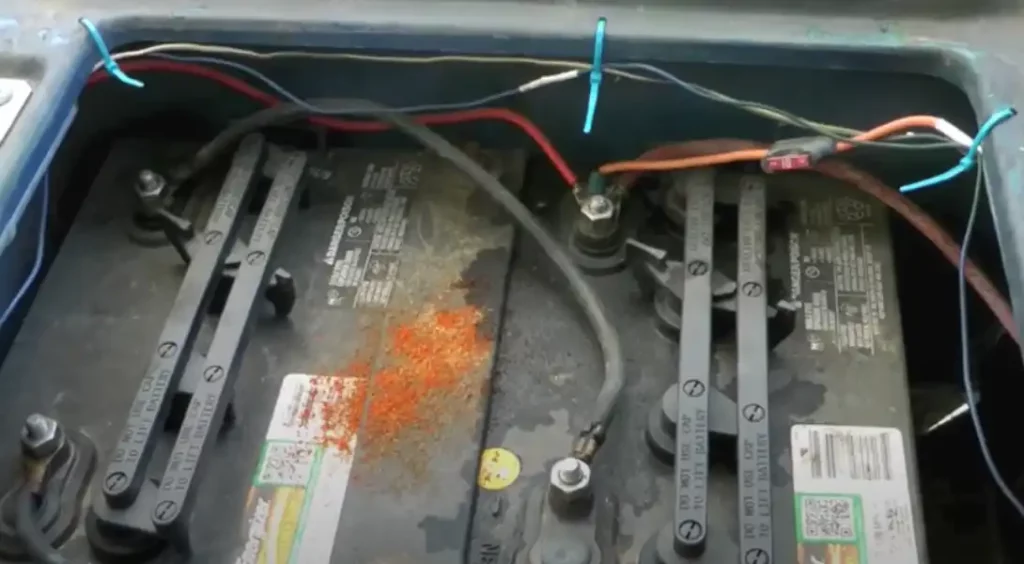
If the key switch works but the cart still won’t go, the batteries are a likely cause. Test them before you assume they are dead.
Most of the time, this problem shows up when batteries or their cells get old and no longer hold a charge as well as they once did.
How do you test battery voltage with a multimeter?
- Fully charge the batteries, then let the cart rest for a few hours so you get a true resting reading.
- Set a digital multimeter to DC volts.
- Measure the whole pack: red probe on the main positive terminal, black probe on the main negative terminal.
- Measure each battery on its own, across its two terminals.
- Compare your readings to the full-charge voltage in your cart manual or the battery maker’s spec sheet.
All the batteries in a pack should read close to each other. One battery that reads clearly lower than the rest is usually the weak one. Because the batteries are wired in series, the weakest battery limits the whole pack.
Should you replace one battery or the whole pack?
If the pack is fairly new and only one battery tests bad, replacing that one battery can work. If the whole pack is old, a single new battery is wired in series with worn ones. The pack will still be held back by the older batteries, so a full set is usually the better long-term choice.
A new battery set may cost between $800 and $1,500, so this can be a pricey fix (Vatrer Power). A 48V cart may use six 8V, four 12V or eight 6V lead-acid batteries, or one 48V LiFePO4 lithium pack. Installation typically adds about $75 to $150, according to a 2026 vendor estimate (Vatrer Power). If you switch to lithium, confirm your charger and controller are compatible first.
Follow these steps to change a battery safely:
- Step 1: Turn the key off and move the Run-Tow/Maintenance switch to Tow/Maintenance. Label each cable, then disconnect the pack’s main negative cable first, followed by the damaged battery’s connections.
- Step 2: Remove the hold-down and lift out the battery. Batteries are heavy, so lift with your legs.
- Step 3: Place the new battery, reconnect each cable to the same terminal it came from, and connect the main negative cable last. Tighten the connections firmly.
- Step 4: Wait at least 30 seconds, then move the switch back to Run.
3. Inspect the ignition switch and replace it if necessary

If the batteries test good and the cart still won’t go, check the ignition (key) switch. This switch turns on the cart’s control circuit.
If the switch fails, the cart won’t start. With the key in the ON position, use a multimeter to check that voltage passes through the switch steadily. If voltage goes in but doesn’t come out, the switch is bad.
A new key switch is cheap. As of November 2026, E-Z-GO key switches run from about $12 for generic 1981-and-up switches to about $45 for a TXT 4-terminal switch with lights (RMI Golf Carts). Buy the one that matches your cart’s terminal count and year.
If you wish to replace your ignition switch yourself, follow these simple steps:
- Step 1: Turn off the key, set the Run/Tow switch to Tow, and label the wires before you disconnect them from the switch.
- Step 2: Remove the face nuts and the rivets holding the ignition console in place. Now pull out the switch.
- Step 3: Install the replacement switch on the plate, reconnect the labeled wires, tighten the nuts, and secure the console back in place.
4. Test and replace the damaged solenoid
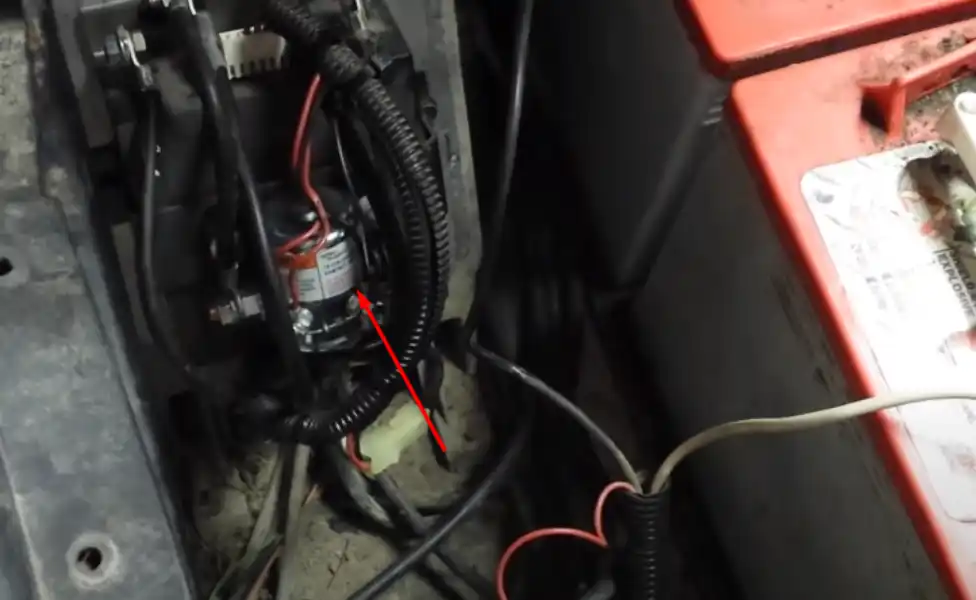
The solenoid is a heavy-duty switch that connects battery power to the controller and motor when you press the pedal. A damaged solenoid can stop your golf cart from moving, especially on older models.
Why does my EZGO click but not move?
A click means the solenoid’s coil is getting a signal. If the cart still doesn’t move, the solenoid’s internal contacts may be burned, the batteries may be too weak under load, or the problem may be further down the line in the F/R switch, controller, cables or motor.
How do you test the solenoid in the cart?
- Listen for the click: Key on, Run selected, Forward selected, then press the pedal. Have a helper press the pedal while you listen near the solenoid. Keep your hands clear of moving parts and lift the drive wheels if possible.
- No click: test the coil. Put the multimeter on the two small terminals and press the pedal. If you get voltage but no click, the coil is likely bad. If you get no voltage, the problem is upstream, such as the key switch, pedal switch, fuse or wiring.
- Click: test the contacts. Put the multimeter across the two large terminals and press the pedal. When the solenoid closes, the reading should drop close to zero. If you still see a high reading after the click, the contacts are burned and the solenoid needs replacing.
Solenoid prices vary by quality. As of November 2026, a 36V E-Z-GO solenoid costs about $22 for aftermarket units and about $52 to $55 for OEM or heavy-duty units, such as part 27855G01 (Cart Mart). Match your cart’s voltage: a 36V solenoid will not work correctly on a 48V cart.
To replace the faulty solenoid, follow these steps:
- Step 1: Turn the key off and select Tow/Maintenance on the Run-Tow/Maintenance switch. On PDS carts, this is how you disconnect the controller from the battery set. You don’t need to unhook the solenoid and controller by hand (E-Z-GO TXT manual). On carts without this switch, disconnect the battery pack.
- Step 2: Label the wires, then remove the terminal nuts and the mounting screws to take out the solenoid.
- Step 3: Install the new solenoid and reconnect every wire to the same terminal. Leave the switch in Tow/Maintenance for at least 30 seconds after the circuit is restored, then return it to Run.
5. Replace faulty forward or reverse switch
A broken Forward/Reverse (F/R) switch is another reason an EZ go electric golf cart won’t move.
Because the F/R switch carries power on its way from the batteries to the motor, its contacts can burn as the switch ages and wears out. A common sign is a cart that works in one direction but not the other.
The best fix is to install a new one. As of November 2026, E-Z-GO forward/reverse switches cost about $50 to $90 for aftermarket or surplus units and up to about $200 for full assemblies (Skycraft Surplus).
Match the OEM part number for your cart. Examples include 70578-G01 or 73036-G01 for 1994-and-up TXT carts, and 74323-G01 for 2003-and-up PDS carts (E-Z-GO manual).
Installing a new forward/reverse switch takes some care, but you can do it yourself if you follow these instructions.
- Step 1: Turn the key off and put the Run-Tow/Maintenance switch in Tow/Maintenance. On carts without that switch, disconnect the battery pack. Then remove the F/R switch cover.
- Step 2: Label every wire before you move it. A phone photo of the wiring also helps.
- Step 3: Loosen the mounting screws, move each wire to the matching terminal on the new switch, and install it. Wait at least 30 seconds before switching back to Run.
How do you check the controller and throttle sensor?
If the batteries, fuses, key switch, solenoid and F/R switch all check out, the controller or throttle sensor may be at fault. The throttle sensor is called the ITS on older carts and the MCOR on newer ones. It tells the controller how far you are pressing the pedal.
- Listen for beeps: Many E-Z-GO controllers report faults with beep codes or codes read by a diagnostic tool. Look up the code in your service manual. Our guide to EZGo electric golf cart beeping explains more.
- Check the sensor wiring: Look for loose plugs, broken wires or water damage at the pedal sensor.
- Watch for throttle symptoms: Jerky starts, no response at part throttle, or full speed with a light touch can all point to a sensor problem.
Sensor and controller output tests use specific voltage ranges that vary by model. Use the service manual for your exact cart, or have a dealer test them.
How do I reset an EZGO golf cart controller?
On carts with a Run-Tow/Maintenance switch, turn the key off and move the switch to Tow/Maintenance. Wait at least 30 seconds, then move it back to Run and try the cart again. E-Z-GO’s manual requires this 30-second wait after any battery, motor or controller power wire is reconnected (E-Z-GO TXT manual). If a fault code returns, the underlying problem still needs to be fixed.
How do you check the motor?
The motor is usually the last thing to check, after power is confirmed reaching it. Look at these parts:
- Motor cables: Check for loose, corroded or burned terminals at the motor.
- Brushes: Worn or stuck brushes can stop the motor from turning or make it run weak.
- Armature: A damaged or burned armature usually means a motor rebuild or replacement.
- Speed sensor: If your cart’s motor has one, a damaged sensor or loose plug can cause the controller to stop the cart.
Also check for brakes that are dragging or wheel bearings that are seized. These can make the cart feel like it has lost power.
When should you call a dealer instead of fixing it yourself?
Use this simple rule. Do it yourself if the fix is a switch position, a fuse, a loose cable, a battery test, or a bolt-on part like the key switch or solenoid, and you are comfortable with the safety steps above.
Call a dealer or golf cart technician if:
- The controller shows fault codes you can’t clear.
- The problem points to the motor, controller or throttle sensor.
- You smell burning, see melted wires, or a fuse keeps blowing.
- A battery is swollen, leaking or very hot.
- You’re converting to lithium and aren’t sure about charger and controller compatibility.
- You don’t own a multimeter or don’t feel safe working near the battery pack.
Frequently Asked Questions (FAQs)
Here are answers to some common questions about keeping an EZ go electric golf cart running well.
How can I maintain the perfect condition of my EZ go electric golf cart?
You need to take action to keep your golf cart in peak condition. Like when your golf carts aren’t in use, charge your batteries, clean the connectors on your batteries, and regularly check the water levels in your batteries.
Besides, if your tires are low on air, fill them up and ensure you don’t pack your golf carts with too much stuff.
How long does an EZ electric golf cart typically last?
How long a golf cart lasts depends on how often it is used, the ground it is driven over, and how well the batteries and other parts are maintained. Regular charging, cleaning and yearly service help a cart last longer.
How can I keep the batteries in good condition?
To keep your battery in good condition, recharge your batteries even while not using the cart and maintain frequent cleaning of the battery compartment.
Additionally, check batteries at least twice a month for loose or damaged wires.
How frequently should my EZ go electric golf cart be serviced?
Try to get your EZ go electric golf carts serviced by a professional once every 12 months. By having a professional maintain your golf carts, you’ll be able to discover several problems that you might miss.
Conclusion
When an E-Z-GO electric cart won’t move, work from simple to complex. Check the Run/Tow switch, F/R selector, charger cord and parking brake first. Then test the batteries, fuses, key switch, solenoid and F/R switch before you look at the controller or motor.
Keep an eye on your golf cart’s condition to avoid surprise breakdowns. Knowing how your E-Z-GO electric cart works, and what can go wrong, will help you fix it faster if it ever stops moving.
Finally, act quickly when you notice a problem. Small issues, like a loose or corroded cable, can turn into bigger and more expensive ones. Always use Tow/Maintenance and wait 30 seconds before switching back to Run after any wiring work.
- Read Also: EZgo Electric Golf Cart Won’t Move: How to Fix the Problems?
- Read Also: EZGO TXT Golf Cart: Recommended Oil Type and Capacity
- Read Also: EZGo Electric Golf Cart Beeping: Understanding and Resolving
- Read Also: Why Is My EZGo Charger Blinking Red? [Troubleshooting Tips]
- Read Also: How to Fix EZGo 48 Volt Golf Cart Won’t Move Problems?