
Quick answer: The best 48 volt golf cart charger is one that matches your cart’s plug, your battery type (lead-acid or lithium) and a 13–17 amp output. For EZGO RXV and TXT 48V carts, our top pick is the FORM 15 AMP charger. It offers 15 amps, smart multi-stage charging, an IP67 rating and weighs about 5.5 lbs.
Getting the right battery charger is crucial for good battery life on your golf cart. A low-quality charger can easily ruin the battery, shorten its life or even damage it beyond repair.
48-volt is one of the most common voltages for golf carts. With that in mind, we bring you a list of the best 48-volt golf cart battery chargers. Let’s check out these ten battery chargers to protect your golf cart’s battery life.
Quick Comparison: 10 Best 48 Volt Golf Cart Chargers
Use this table to narrow the list by plug and amps first. “Not listed” means the spec was not confirmed, so check the current product page before you buy.
| Charger | Amps | Fits / plug | IP rating | Weight | Cord length | Warranty |
|---|---|---|---|---|---|---|
| FORM 15 AMP (Best overall) | 15A | EZGO RXV & TXT | IP67 | About 5.5 lbs | Long (length not listed) | Not listed |
| Revenge 15 AMP Club Car | 15A | Club Car 48V, 3-pin round plug | Not listed | Not listed | Not listed | Not listed |
| Revenge 17 AMP (Best for speed) | 17A | EZGO RXV connector | IP67 | Not listed | 16 ft | Not listed |
| Golf Cart King 17 Amp | 17A | Yamaha G19 & G22, 2-pin plug | Not listed | Not listed | Not listed | Not listed |
| Revenge 15 AMP Yamaha | 15A | Yamaha G29 Drive & Drive 2 | IP67 | Not listed | Not listed | Not listed |
| Fat Cat Lester Links (Best for durability) | 13A | Club Car PowerDrive plug | Not listed | Not listed | Not listed | Not listed |
| Traktronix Supercharger | Not listed | EZGO RXV & TXT | Not listed | About 4.44 lbs | 15 ft | Not listed |
| Abakoo 48V 15A | 15A | Three-prong connector (check fit) | IP67 | Not listed | Short | Not listed |
| Ebusin 48V | 15A | Check listing for your cart | None listed | About 5.5 lbs | 13 ft | 3-year warranty, 3-month returns |
| Eseegoo 15A | 15A | EZGO TXT/RXV, triangle-style RXV plug | IP67 | Not listed | Not listed | Not listed |
For a benchmark, the Battery Tender PowerPlus 48V 15A charger is rated IP68 and weighs about 9.3 lbs. That helps you judge whether a charger’s IP rating and weight are typical for this class.
Warranty and support: Of the ten, only Ebusin lists a clear warranty (three years) plus a three-month return window. For the others, check the seller’s page for warranty length and who handles claims before you buy. Support quality matters because a charger that fails out of warranty usually means buying a new one.
Tips For Extending The Life Of Your 48 Volt Golf Cart Battery
Using a good quality charger is a key factor in prolonging the battery life of your golf cart. But apart from that, there are several tips you can follow to extend the lifespan of a 48-volt battery.
Check out these helpful tips below –
- Don’t let the battery run out of voltage till it’s empty. Deep discharges shorten battery life, so recharge after each use.
- Avoid overcharging your golf cart battery
- Try protecting the battery from dirt buildup and corrosion as much as possible.
- Ensure the battery is fully charged after you use it for a while.
- Following a proper maintenance routine is very crucial for extending battery life.
- When watering the batteries, use only distilled or deionized water.
- Check water levels regularly. Keep the plates covered, but don’t overfill.
- Add water after charging, not before. Water added to a discharged battery can overflow as the electrolyte expands during charging.
- Use the battery as often as you can.
- Maintain proper storage methods to retain battery life.
Following these tips can help extend battery life to some extent. But much of that effort is wasted if the battery and the charger are low quality.
That’s why it’s important to get a high-quality battery and use a good charger that matches it.
Best 48 Volt Golf Cart Battery Charger?
The battery chargers in this list are all built for 48-volt carts. The main thing to get right is fit: the charger must match your cart’s plug and your battery type.
Major differences in the chargers are in their features and the value they can offer. Get the charger that meets your requirements the best –
1. FORM 15 AMP EZGO RXV & TXT Battery Charger – Best overall
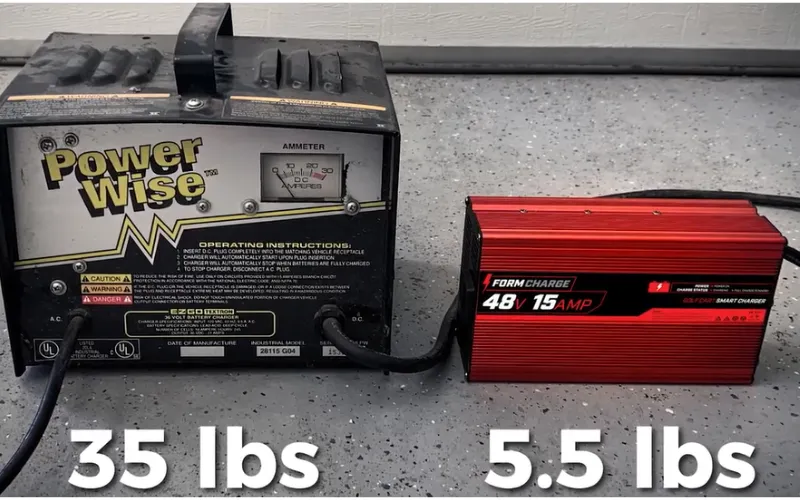
If you are looking for a charger with portability and power for an EZGO RXV or TXT, this can be the perfect pick for you. This charger from FORM has the features you need for convenient charging.
Starting with the power, you get 15 AMPs on it to charge your batteries quickly. With its smart 7-stage charging technology, you won’t have to sit there and wait for the battery to be fully charged. It stops charging the battery as soon as it’s done.
What makes the charger great is the portability factor. It weighs about 5.5 lbs in total, so it’s easy to move around your house and garage. And if you want to keep it in one place, you can also mount it on a wall.
Coming to the build quality, this charger has an IP67 rating. That means it is designed to keep out dust and resist water exposure. It still isn’t a reason to leave it out in the rain, so store it under cover.
On top of everything else, you get a very long cord with this battery charger for added convenience. The charger doesn’t need to be cramped next to the cart to charge your golf cart batteries.
Pros
- Very easy to move around
- Convenient long cord
- Rapid charging feature
- Smart charging standby mode
- Great value for money
Cons
- Connector is not that sturdy
- Can cause issues after a year
Check Latest Price
2. Revenge Golf Cart Parts & Accessories 15 AMP High-Speed Club Car Battery Charger
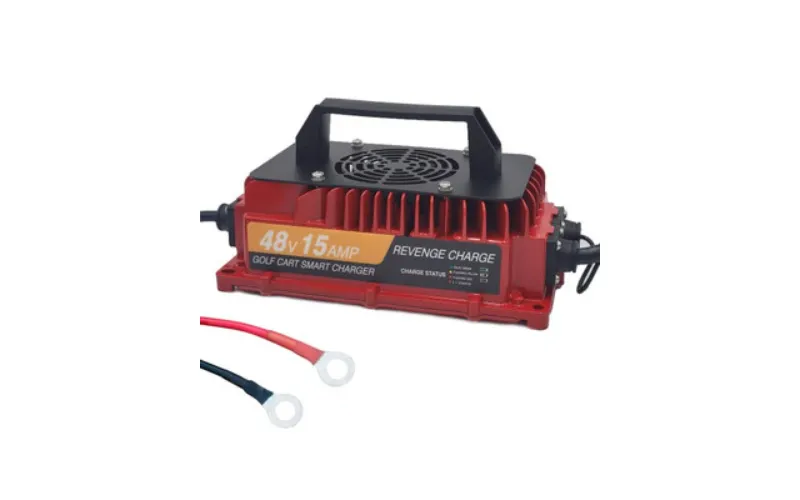
When it’s about charging your Club Car batteries safely and quickly, the Revenge golf cart charger is a top contender. It has features that charge your batteries in a short time while helping protect the battery’s longevity.
For starters, the charger has 15 amps of output, so it can charge a 48-volt pack quickly. It has a 3-pin round plug, so check that it matches the charging receptacle on your Club Car before you buy.
Its intelligent charging system is the feature that sets the charger apart. It lowers the charger’s amperage as your batteries get close to full. This helps you avoid overcharging for better battery longevity.
The charger is sold for Club Car carts, which use an onboard computer (OBC) to control charging. Keep in mind that Club Car 48V chargers need a working OBC to start. If your old charger stopped working, test the OBC before assuming any new charger will fix the problem. See the OBC section below for details.
On top of everything else, using the charger is very simple. Even if you have no experience with a golf cart battery charger, the instructions make it easy to operate. And it comes with safety features to back you up as well.
Pros
- It’s lightweight and easy to carry
- Packs enough power for rapid charge
- Smart charging feature to avoid overcharging
- Built for Club Car 48V carts
- Resistant to water and dust
Cons
- Tech support isn’t that great
- The charger is a bit noisy
Check Latest Price
3. Revenge 48volt 17amp Golf Cart Battery Charger with EZ-Go RXV connector – Best for speed
Here’s another charger from Revenge, but this one has more output than the previous one. So, if you want a faster charger for an EZGO RXV-style plug, this one might be the right fit.
The main reason to pick this one is its 17 amp output. More amps means the charger can push more current during the bulk stage, so the pack fills faster than with a 13–15 amp charger. It also has an equalization stage that helps bring the pack to a proper 100% state of charge.
Along with the power, you also get solid build quality. The charger carries an IP67 rating for dust and water resistance.
That gives it good protection in a garage or shed, but it’s still smart to keep it dry and out of the weather.
Another thing to love about the battery charger is that you don’t need to keep it close to the outlet. It comes with a 16-foot cord that doesn’t tangle easily, either.
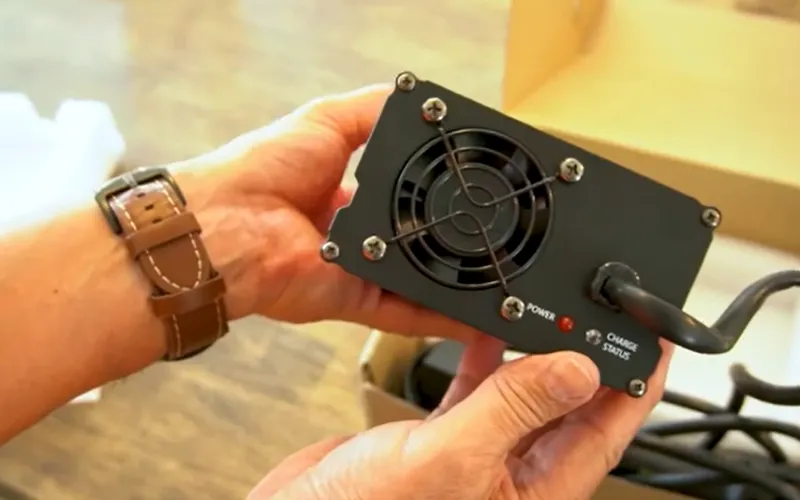
Topping things off is the meter on the front of the charger. Using the meter, you can easily see the charging status of your battery. It’s a very handy feature to have.
Pros
- Very solid build quality
- Compatible with a lot of 48-volt batteries
- Powerful for quick charging
- Resistant to dust and water
- Features smart charging abilities
Cons
- The indicator LEDs may be faulty at times
- Customer service can be disappointing
Check Latest Price
4. Golf Cart King 48 Volt 17 Amp Yamaha G19 & G22 Golf Cart charger
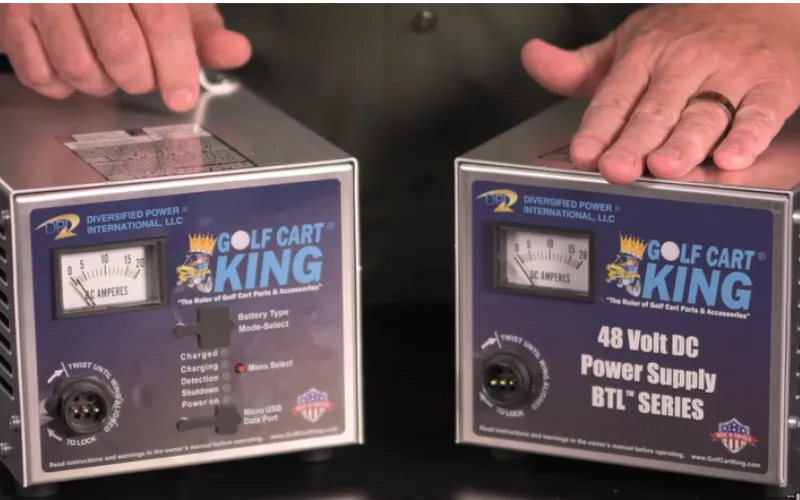
For Yamaha G19 and G22 owners with a 48-volt setup, this charger can be a good option to replace your original charger.
It’s built around the Yamaha G19/G22 plug, which makes it one of the more direct replacement picks for those carts.
First, it’s a 17 amp charger. Note that 17 amps is the DC output to your batteries, not the current it pulls from the wall. Check the AC input rating on the label to make sure your outlet and circuit can handle it (see the safety section below).
Also, this output lets you charge your batteries faster than a typical 15 AMP battery charger.
A charger that brings the pack to a true full charge helps you get the range your batteries are capable of.
A charger can’t add capacity to worn batteries, though. If range is still poor after full charges, test the batteries.
Golf Cart King’s customer service is another advantage. Good support gives users reassurance if something goes wrong, which makes the charger a safer buy.
Something that makes it a lot more appealing is the price of the charger. It typically costs less than you would expect from chargers with similar specifications. For the quality, the price is reasonable and you get good value out of it.
Pros
- Performs as well as OEM chargers
- Very easy to setup and use
- Comes at an affordable price
- 17 amp output for faster charging
- Excellent customer service
Cons
- Not compatible with all batteries
- The 2-pin plug won’t fit every cart receptacle
Check Latest Price
5. Revenge Golf Cart Parts & Accessories 15 AMP Yamaha G29 Drive & Drive 2 Battery Charger
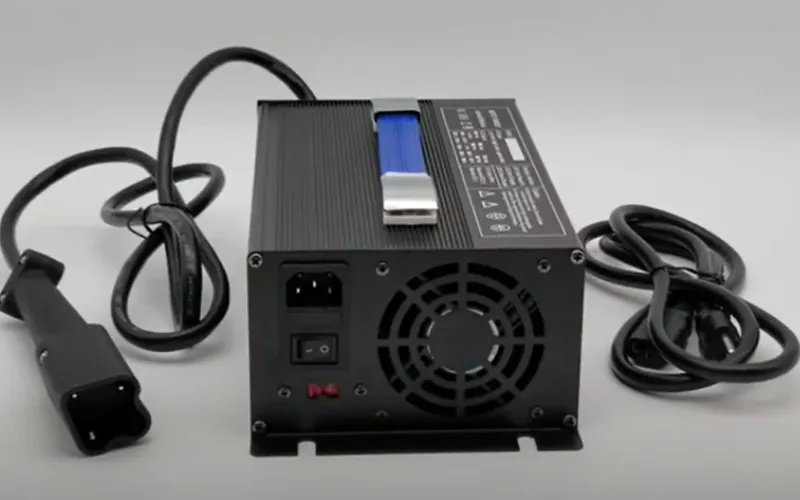
If you have a Yamaha Drive series golf cart, you might want this charger as an OEM replacement. It’s designed for the Yamaha G29 Drive and Drive 2, from the plug to the charging features.
One benefit of this charger is that it brings the pack to a full charge, so you start each round with the most range your batteries can give. Even though it’s 15 amps, it still charges your battery quickly.
Speaking of charging, it comes with smart charging features as well. Whenever the battery is fully charged, the charger stops charging. With this feature, you don’t have to worry about overcharging your batteries.
Another strong point is the heavy-duty build of the charger. It also carries an IP67 rating for water and dust resistance. That adds protection in a garage, though you should still store it out of the weather.
Something that makes using the charger very easy is its indicator lights and voltmeter.
Both are easy to understand, so even beginners can tell what is happening. And with quick customer service, usability shouldn’t be a problem with this one.
Pros
- Excellent customer service
- Solid build quality
- Easy to use and setup
- Automatically stops when fully charged
- Charges battery quite fast
Cons
- It’s very heavy to move around
- The cord could be a bit longer
Check Latest Price
6. Fat Cat Golf Battery Charger, Lester Links Series, 48V/13A Club Car PowerDrive Plug – Best for durability
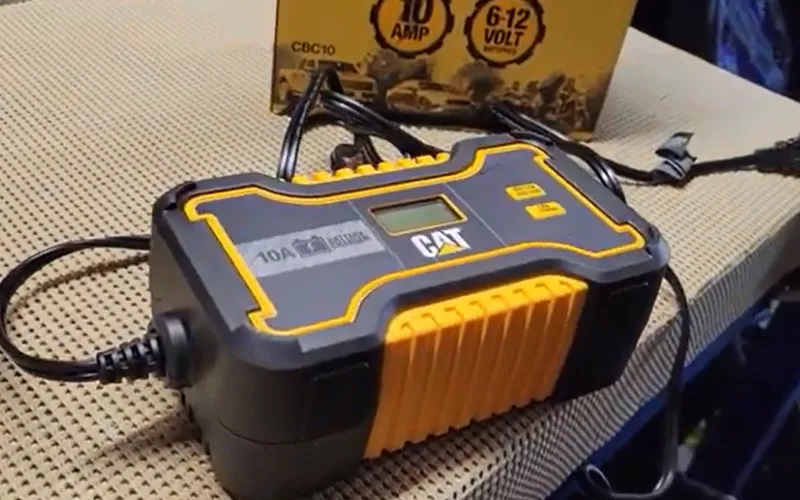
For anyone new to third-party battery chargers, this Club Car PowerDrive-plug charger can be a good pick.
It has a clear instruction manual and responsive customer support to back you up. From setup to daily use, everything is easy.
The charger uses microprocessor controls to manage charging, which helps protect battery capacity and longevity.
These controls adjust the charge as the batteries fill, so the pack gets the right amount of current at each stage.
Storing your cart over winter is easier, too. The charger has a winter storage mode designed to keep the batteries maintained while the cart sits.
With this charger, you won’t have to think much about overcharging or undercharging your battery. That helps protect your batteries from internal damage.
While it has less output than some other chargers here, it consistently puts out about 13 amps.
That’s enough to charge your batteries at a normal speed. Expect a somewhat longer charge time than with a 15–17 amp charger.
Pros
- Easy-to-read instructions
- Very responsive customer service
- Winter storage feature
- Smart charging system enabled
- High-quality build
Cons
- The charger is a bit large
- It gets a bit too noisy
Check Latest Price
7. Traktronix Supercharger EZGO RXV & TXT Battery Charger for 48 Volt Golf Carts
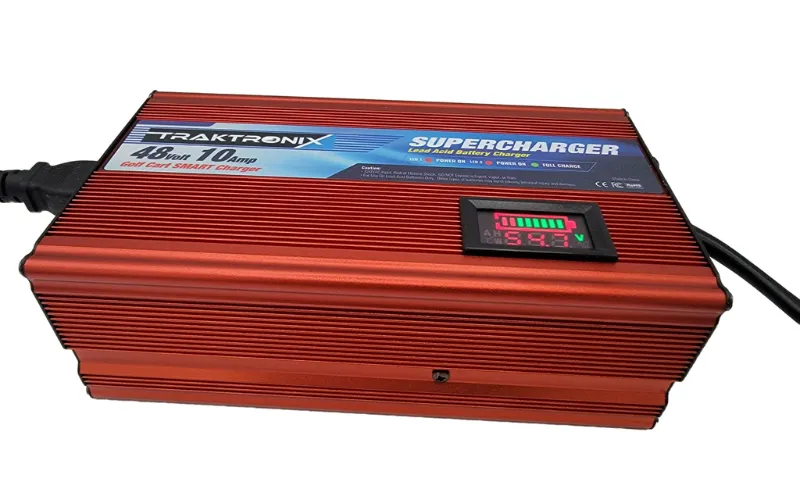
If you don’t mind a longer charge time and want to save some money, this charger might be it.
The Traktronix charger for EZGO RXV and TXT carts has handy features at a reasonable price.
The most interesting feature of this battery charger is its 3-stage smart charging with a trickle mode.
This lets the charger stop charging your battery as soon as it’s full, so you won’t end up overcharging and damaging it.
Using the charger is easier thanks to its digital display.
It shows your battery’s voltage and charging status, so you won’t have to wonder whether the charger is working.
Another benefit you get with this charger is its long cord. It has a 15-foot cord attached, which is enough to conveniently reach your golf cart.
Moving this charger around is easy. It weighs about 4.44 lbs, making it the lightest charger in this list.
Pros
- Digital display helps track charging status
- Features smart charging modes
- Long cable for convenience
- Lightweight and portable
- Affordable price
Cons
- Doesn’t include any instructions
- No rapid charging option
Check Latest Price
8. Abakoo 48V 15A Golf Cart Battery Charger
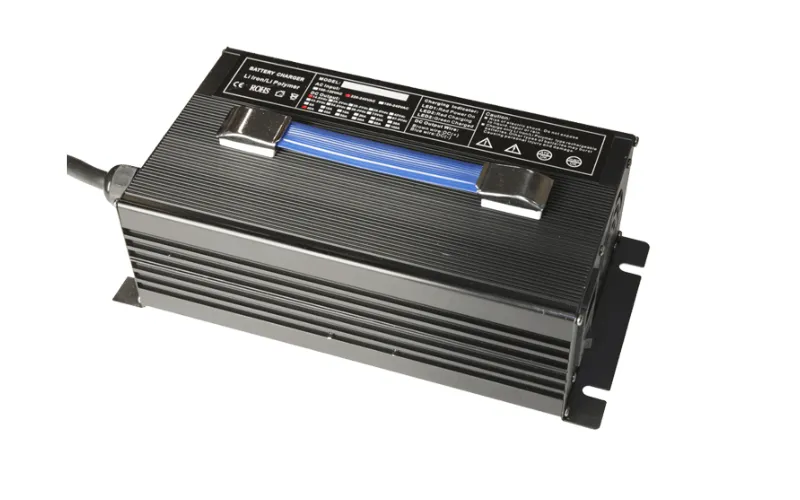
The Abakoo 48V golf cart battery charger combines smart charging features with an affordable price. Its features are aimed at protecting your golf cart batteries over the long run.
Fast charging is one of the key features of this battery charger. With 15 amps of output, it charges a 48V pack in less time than lower-amp chargers.
The charger uses a three-prong connector, so make sure it matches your cart’s charging receptacle before you buy.
Convenience is another strong suit. The charger has a handle that makes it easy to carry around. Its exact weight wasn’t confirmed, so check the product page if weight matters to you.
Along with that, you also get a trickle charging mode. It switches to trickle charge automatically so the charger doesn’t overcharge or undercharge your battery.
Also, the float charge feature keeps the battery topped up, which helps its performance over time.
For weather protection, the Abakoo 48V 15A charger is listed with an IP67 rating for dust and water resistance. That’s good protection for garage use, but keep it out of standing water and rain.
Pros
- Charges battery quickly
- Carry handle for easy moving
- Automatic shuts off charging
- IP67 dust and water resistance
- Value for money
Cons
- Not compatible with every cart
- The cord is a bit too short
Check Latest Price
9. Ebusin 48 Volt Golf Cart Battery Charger
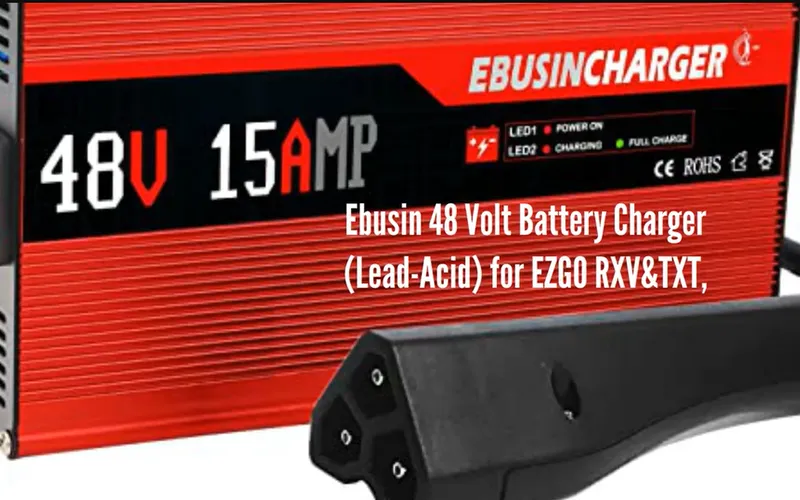
If you want to save money on a charger and still get solid value, this is a good charger to consider.
It usually costs less than other chargers with similar features, and the overall value is strong.
Its main selling point is quick charging. With a 15 amp current rating, the seller says it can charge a 48-volt golf cart pack in about 4 to 7 hours. Actual time depends on how deeply the pack was drained and its size.
It’s not just limited to quick charging; you also get smart charging features on the charger.
Its trickle charging feature stops charging as soon as the battery is full. If the battery charge starts to drop, it resumes charging until it’s full again.
The light, compact design is also worth praise. It’s listed at about 5.5 lbs, so moving it around your house is easy. And with the listed 13-foot cable, you won’t need an outlet right next to the cart.
Ebusin backs the charger with a three-month return guarantee and a three-year warranty.
Both come at no extra cost, which is the most generous coverage listed among these ten chargers.
Pros
- Charges batteries very fast
- Lightweight and portable
- Comes with clear instructions
- Suitable for most 48-volt club carts
- Smart charging feature
Cons
- Not the best durability
- No weather resistance rating
Check Latest Price
10. Eseegoo 15A Golf Cart Battery Charger
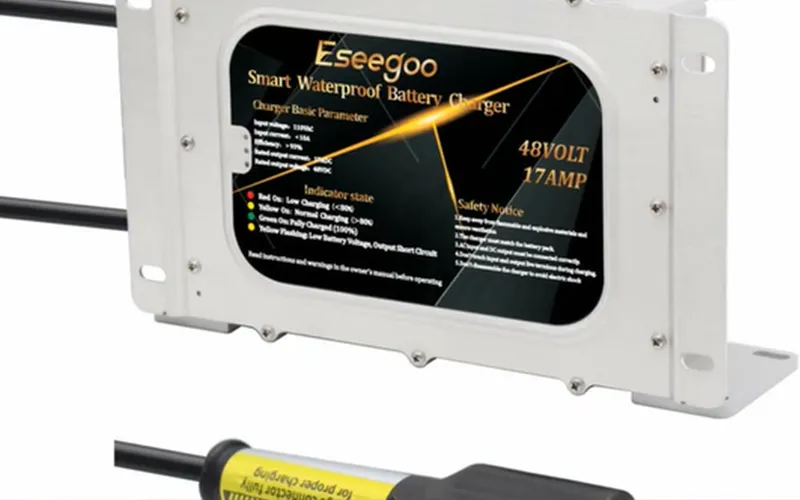
This golf cart battery charger is only for owners of a 48-volt EZGO TXT or RXV with the triangle-style RXV plug.
For those carts, it’s a practical replacement for the OEM charger with handy features.
For starters, the charger has a 15 amp current rating, which charges the battery faster than lower-amp chargers.
Once the charging is complete, it goes to float mode, which keeps the battery topped up and supports longer life.
The charger is listed as IP67 waterproof. That means good dust and water resistance for garage use. Still, keep it out of rain and standing water.
To prevent overcharging or undercharging your battery, the charger features the trickle charging mode.
So, whenever the battery is fully charged, the charger automatically stops charging the battery. A handy feature to have.
Build details such as case material vary by listing, so check the current product page if construction matters to you.
Wherever you place it, give the charger open air around it so it can shed heat while it works.
Pros
- Helpful LED indicators
- Quick charging ability
- IP67 dust and water resistance
- Great value for money
- Advanced charging features
Cons
- Customer support isn’t good at all
- Not compatible with all cart batteries
Check Latest Price
Factors To Consider When Choosing A 48 Volt Golf Cart Battery Charger
When you shop for a 48-volt golf cart battery charger, a few factors decide whether it will work well for your cart.
Considering these factors can guide you toward the right battery charger for your needs. So, let’s take a look at the factors you need to think about –
Power: how many amps should a 48 volt charger be?
Since we are talking about only 48-volt chargers, you won’t have to consider the voltage here.
For the power, focus on the amp rating of your charger. A higher amp rating means the charger can charge your 48-volt battery faster.
Usually, try to get a charger rated 15 amps or more. With that rating, you can typically expect to charge your golf cart batteries in about 3–7 hours. Lower ratings, like 13 amps, will take longer.
Plug type
Of course, you have to check that the charger’s plug fits your cart’s charging receptacle. There is no “better” plug here.
If your cart takes a 2-pin plug, you buy that. If it takes a 3-pin plug, you buy a 3-pin charger. Shape matters too: round, triangle and D-style 3-pin plugs are not interchangeable. See the plug table below.
Battery type: lead-acid or lithium
Match the charger to your battery chemistry, not just the voltage. Lead-acid and lithium batteries need different charging profiles. Most chargers in this list are marketed for lead-acid packs, so check the listing before using any of them on lithium. More on this below.
Smart charging modes
Having a smart charging mode on your battery charger can be very important. It lets the charger shut off when the battery is fully charged, preventing overcharging.
You can also find chargers with trickle charging mode, which stops charging when the battery is full. But if the battery level goes below a certain level, it resumes charging automatically.
With these features on your charger, you can expect a longer battery life and improved battery performance.
Weather resistance
It’s not a necessity, but a weather-resistant charger can always be helpful.
It helps most if you charge in a dusty garage, a shed or anywhere water might splash on the charger.
Typically, an IP67 rating works out quite well. IP68 offers a higher level of water protection. Neither rating makes a charger safe to leave out in the rain, so store it under cover.
Safety certification
Look for a recognized safety listing mark, such as UL or ETL, on the charger or its label. These marks show the product was tested by an independent lab. If a listing doesn’t mention one, ask the seller before you buy.
Display and indicators
For ease of use, look for a display, meter or LED indicators. They show whether the charger is working properly and how far along the charge is.
Size and weight
It’s always better to look for a compact charger that is lightweight as well. This way, you can carry it around easily and store it without trouble.
But don’t sacrifice the build quality too much to get a lighter-weight charger. Try to balance both.
Which Charger Plug Does My Golf Cart Need?
Your charger plug must match the receptacle on your cart. This table shows which chargers in this list are sold for each cart family. Always compare the plug photo on the listing with your cart’s receptacle before buying.
| Cart (48V) | Plug style named in listings | Chargers in this list |
|---|---|---|
| EZGO RXV | Triangle-style RXV plug | FORM, Revenge 17A, Traktronix, Eseegoo, Abakoo (check fit) |
| EZGO TXT 48V | Varies by year; many use the RXV-style plug | FORM, Traktronix, Eseegoo |
| Club Car (DS, Precedent and other OBC carts) | PowerDrive plug / 3-pin round plug | Fat Cat Lester Links, Revenge 15A Club Car |
| Yamaha G19 & G22 | 2-pin plug | Golf Cart King 17A |
| Yamaha G29 Drive & Drive 2 | Yamaha Drive plug | Revenge 15A Yamaha |
If you’re unsure, take a clear photo of your cart’s receptacle and send it to the seller. Don’t cut and splice plugs unless the charger maker approves it.
How Do I Tell If My Golf Cart Is 36 or 48 Volt?
Count the batteries and the fill holes on each one. A 48-volt cart uses either six 8-volt batteries (four fill holes each) or four 12-volt batteries (six fill holes each).
Each fill hole is one cell of about 2 volts. Multiply cells per battery by 2, then by the number of batteries. For example, six batteries with three holes each is 6 × 6V = 36V, so that cart needs a 36-volt charger.
Can I Use a 48-Volt Charger on a 36-Volt Golf Cart?
No. Don’t use a 48-volt charger on a 36-volt cart. The 48-volt charger pushes a higher voltage than a 36-volt pack is built for, which can overcharge and damage the batteries and the cart’s electrical parts. Always match charger voltage to pack voltage.
How Long Does It Take to Charge a 48-Volt Golf Cart?
A standard charger with a 10 to 12 amp rating typically takes about 6 to 9 hours. A 15 to 18 amp charger usually takes about 3 to 7 hours. The exact time depends on how far the pack was drained, battery size and age, and temperature.
Can I Use a Lead-Acid Charger on Lithium Golf Cart Batteries?
Not unless the battery maker says it’s OK. Many newer 48V carts use lithium batteries, and lithium packs need a charger with a lithium charging profile set for that pack.
Lead-acid chargers often include float and equalization stages. Those stages are meant for lead-acid cells and are not what a lithium pack’s battery management system expects. Using the wrong charger can stop charging early, trigger pack protection, or harm the battery.
- Lead-acid cart: use a lead-acid charger at your pack’s voltage.
- Lithium cart: use the charger supplied or approved by the battery maker.
- Converted from lead-acid to lithium: replace the old charger too, or confirm it has a selectable lithium mode.
What Are the Charging Stages of a Lead-Acid Golf Cart Charger?
Smart lead-acid chargers fill the pack in stages. The names vary by brand (“7-stage”, “3-stage”), but most follow this pattern:
- Bulk: the charger delivers its full rated amps. Most of the charge goes back in here, and higher-amp chargers finish this stage faster.
- Absorption: voltage is held steady while current tapers off. This tops off the cells without overheating them.
- Float (or trickle/maintenance): a low voltage keeps the full pack topped up without overcharging.
- Equalization: a controlled overcharge on some chargers that helps balance cells in flooded lead-acid batteries. It’s not for sealed or lithium batteries unless the maker allows it.
What Is a Golf Cart Onboard Computer (OBC)?
An onboard computer (OBC) is a control module inside the cart that manages charging. Since 1995, 48-volt Club Car carts have used an OBC to control charging, and Club Car 48V chargers need a working OBC to start.
This matters when you shop. A Club Car charger has to work with the OBC system. A charger without OBC support, or a cart with a failed OBC, may not charge at all.
Why won’t my Club Car 48 volt charger turn on?
The most common cause is a faulty OBC, not a bad charger. Because the charger needs a working OBC to start, a dead OBC can make a good charger look broken. Work through these checks before buying a new charger:
- Confirm the wall outlet works by plugging in another device.
- Inspect the charger plug and the cart receptacle for burnt, loose or corroded pins.
- Check the pack voltage with a multimeter. A very deeply drained pack may not be detected by some automatic chargers.
- Have the OBC tested. If it has failed, ask a golf cart technician about repair, replacement or bypass options for your model.
Should I Leave My Golf Cart Plugged In All the Time?
It depends on your charger. If it has an automatic float or maintenance mode and the manual says it can stay connected, leaving it plugged in is generally fine. Older or basic chargers without automatic shutoff should be unplugged once charging finishes.
Either way, recharge after every use instead of running the pack low. If you have flooded batteries, keep checking water levels, since charging uses up water over time.
How Do I Check My Battery Pack Before and After Charging?
A quick voltage check tells you whether the charger is doing its job. You need a basic digital multimeter.
- Set the multimeter to DC volts.
- Touch the probes to the pack’s main positive and main negative terminals. Note the reading before you plug in.
- Charge fully, then let the pack rest a few hours. Readings taken right after charging read high.
- Measure the pack again. It should read clearly higher than before charging.
- Measure each battery on its own. One battery reading well below the others can drag down the whole pack.
For flooded batteries, a hydrometer reading of each cell gives a more precise state-of-charge check. If the pack won’t rise after a full charge, the problem may be the batteries, not the charger.
How Do I Know If My Golf Cart Charger Is Bad?
A charger is likely failing if it shows any of these signs, even with a working outlet and healthy batteries:
- No lights, fan or meter movement when plugged in.
- It starts, then shuts off within minutes every time.
- It never shuts off, or the batteries get hot and bubble heavily.
- Pack voltage doesn’t rise after a full charge cycle.
- It trips the breaker, smells burnt, or has a damaged cord or plug.
Should you repair or replace a golf cart charger?
Rule out the cheap fixes first: the outlet, the plug and receptacle, and on Club Car, the OBC. If the charger is under warranty, contact the seller before opening it. Opening the case can void coverage.
Replace the charger if it smells burnt, trips breakers, overheats the batteries, or has failed internal electronics. Those faults are a safety risk and are rarely worth fixing at home. Never open a charger while it is plugged in.
How Do I Charge a 48 Volt Golf Cart Safely?
Charge in a well-ventilated area. Flooded lead-acid batteries give off hydrogen gas while charging, and hydrogen is flammable. Keep sparks, flames and smoking away, and don’t charge in a sealed space.
- Plug into a grounded outlet that is in good condition.
- Avoid extension cords if you can. If the manual allows one, use a short, heavy-duty, grounded cord rated for the charger’s input current.
- Avoid sharing the circuit with other big loads like freezers or power tools.
- Keep the charger dry and give it open air so it can cool.
- Add water to flooded batteries after charging, not before.
How much current does a 15–17 amp charger draw from the wall?
Less than the amp rating suggests. The 15 or 17 amp figure is DC output to the batteries, not AC draw from the wall. Output power is roughly pack voltage times amps. For example, 48V × 15A is about 720 watts, and the pack voltage rises above 48V as it charges.
On a 120V outlet, that output plus conversion losses usually works out to well under 15 amps of wall current. The exact number varies by model, so read the AC input rating printed on the charger’s label and make sure your circuit can handle it.
Read More:
How to Do Ez go Golf Cart Charger Troubleshooting? [With Easy Solutions]
EZ Go Golf Cart Electric Motor Troubleshooting & Fix Guide
EZ Go Golf Cart Controller Troubleshooting Guide! Things You Need To Do!
Club Car Golf Cart Battery Light Stays On | What to Do?
Final Words
Finishing things off, now you know what makes the best 48-volt golf cart battery charger for your cart: the right plug, the right battery chemistry and enough amps. Most of the chargers here offer solid quality and can help your batteries last longer.
Among these 10 choices, FORM 15 AMP EZGO RXV & TXT Battery Charger is the best option for EZGO owners considering the value you get from it. Club Car and Yamaha owners should pick the charger in this list built for their plug.
Frequently Asked Questions
What is the best 48 volt charger for an EZGO RXV or TXT?
The FORM 15 AMP charger is the top pick for EZGO RXV and TXT 48V carts. It has 15 amps of output, smart multi-stage charging, an IP67 rating and weighs about 5.5 lbs. It also has a long cord and can be wall-mounted. Always confirm the plug matches your cart’s receptacle before buying.
Which 48 volt golf cart charger has the best warranty?
Of the ten chargers compared, only Ebusin lists a clear warranty. It comes with a three-year warranty and a three-month return window at no extra cost. For the other chargers, check the seller’s page for warranty length and who handles claims, since a charger that fails out of warranty usually means buying a new one.
Will a new charger fix poor golf cart range?
Only if the old charger wasn’t fully charging the pack. A charger that brings the batteries to a true full charge helps you get the range they’re capable of. But a charger can’t add capacity to worn batteries. If range is still poor after full charges, test the batteries, since they may be the real problem.
Should I add water to golf cart batteries before or after charging?
Add water after charging, not before. Water added to a discharged battery can overflow as the electrolyte expands during charging. Use only distilled or deionized water. Check levels regularly and keep the plates covered, but don’t overfill. Flooded batteries use up water over time as they charge, so keep checking.
Can I cut and splice a charger plug to fit my golf cart?
Don’t cut and splice plugs unless the charger maker approves it. Round, triangle and D-style 3-pin plugs aren’t interchangeable, and 2-pin plugs only fit 2-pin receptacles. Buy a charger sold for your cart’s plug instead. If you’re unsure, send the seller a clear photo of your cart’s receptacle before you buy.