
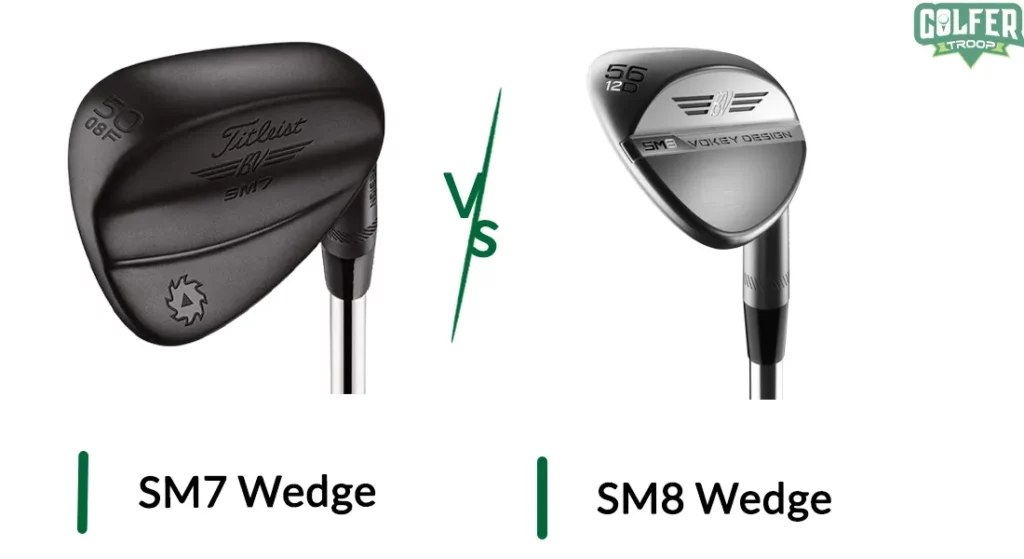
Quick answer: The main difference between the Titleist Vokey SM7 and SM8 is the center of gravity. The SM8 (2020) moves the CG forward, in front of the face. It does this with longer hosels and tungsten in the toe, which gives up to 7% more MOI in the higher lofts. The SM7 (2018) is older and usually cheaper. Both are now discontinued.
Wedges are the most reliable clubs for chipping the golf ball close. They are good for shots from the sand and for getting the ball up quickly. The Titleist SM7 and SM8 are two of the best-known Vokey wedges, but they have real differences.
The core difference between these two wedges is the center of gravity. The Titleist Vokey SM8 moves the CG forward, which gives it up to 7% more MOI than the SM7 in the higher lofts.
But that’s not all. Finishes, launch price, release date and grind choice also separate these wedges, and we cover each one in this SM7 vs. SM8 writeup. We also explain grinds, bounce, loft gapping and how to buy a used Vokey safely.
Overview of SM7 Wedge
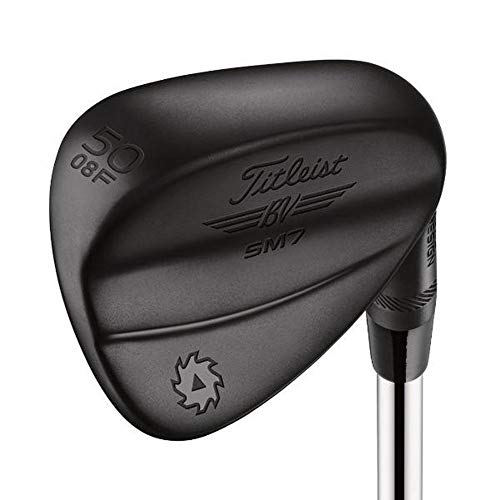
Titleist New SM7 Jet Black Wedge RH 50 12 F-Grind Steel S200
Pros
- Maximized spin control
- Six grind options
- Impressive craftsmanship
- Detailed design
- Lower launch price than the SM8
Cons
- Variations can be complex to understand
- Discontinued, so most copies are used or closeout
The Titleist Vokey SM7 is a true scoring wedge built to help you hit short shots with accuracy. Titleist announced it on January 22, 2018, and it reached golf shops on March 9, 2018.
It launched in three finishes: Tour Chrome, Brushed Steel and Jet Black. Titleist added a Slate Blue finish later. The design has clean, careful detailing.
The feel of the wedge is solid. Spin comes from spin-milled grooves that Titleist inspects one by one. The groove area is heat treated to help the grooves, and the spin they create, last longer.
The SM7 uses a progressive center of gravity. That means the CG height changes with the loft. Lower-lofted wedges and higher-lofted wedges each get a CG placed to suit the shots they are built for. You also get six grinds and many loft and bounce combinations to choose from.
Overview of SM8 Wedge

TITLEIST SM8 Tour Chrome Wedge, Men, Chrome, 54.10
Pros
- Forward center of gravity
- Up to 7% higher MOI in the higher lofts
- Ample grind options
- Appealing feel and sound from shots
- Four variants with different finishes
Cons
- Replaced by newer Vokey models (SM9, SM10 and SM11)
- Higher launch price than the SM7
The main attraction of this version is the forward center of gravity. It is what makes it stand out from the Titleist SM7. Titleist announced the SM8 in January 2020. Pre-orders opened February 11, and the wedge reached golf shops on March 6, 2020.
This wedge from Titleist comes with six grind options, which gives players plenty of ways to match the club to their swing and course.
Also, it comes in four different finishes, so players can pick the look they like best.
The SM8 is built for stability and control on short shots. Players get a crisp feel on short chips, and the sound and feel at impact are pleasing.
When it comes to the center of gravity, the SM8 keeps the progressive, loft-by-loft CG height of earlier Vokeys. Then it moves the CG forward, in front of the face. Titleist did this by lengthening the hosels and adding high-density tungsten low in the toe. The result is a higher MOI in the higher lofts.
SM7 Vs. SM8: Comparison Chart
The Titleist Vokey SM8 is the direct follow-up to the SM7. They share a lot, but there are clear differences. The chart below sums them up:
| Factors | SM7 | SM8 |
| Announced | January 22, 2018 | January 2020 |
| In golf shops | March 9, 2018 | March 6, 2020 |
| Center of gravity | Progressive CG (height changes by loft) | Progressive CG height, moved forward in front of the face |
| How the CG was moved | — | Longer hosels plus tungsten low in the toe |
| MOI | Baseline | Up to 7% higher in the higher lofts |
| Stock shaft | Dynamic Gold S200 | True Temper Dynamic Gold S200 (other shafts by custom order) |
| Finishes | 3 at launch (Tour Chrome, Brushed Steel, Jet Black), Slate Blue added later | 4 |
| Grind Types | 6 | 6 |
| Grooves | Spin-milled, individually inspected, heat-treated groove area | Spin-milled, individually inspected, heat-treated groove area |
| Launch price (MAP) | $149 | $159 |
| Sold new today? | No (discontinued) | No (replaced) |
Exact loft, bounce, lie and swing weight vary by loft and grind. Check Titleist’s spec chart for the specific model before you buy, especially on the used market.
What are the differences between SM7 and SM8 wedges?
Both the Titleist SM7 and SM8 wedges come with differences and similarities. The core difference involves the center of gravity. Here is the list of those differences below:
Center of Gravity
The CG, or center of gravity, is crucial when selecting golf clubs and wedges. It influences the ball’s spin, launch, trajectory and forgiveness. It also plays a big role in how stable the club feels through impact.
Between the CG of both these wedges, the Vokey SM8 has the edge over the SM7. Earlier Vokey wedges, including the SM6 and SM7, used a progressive CG that changed height by loft. The SM8 kept that vertical CG plan and added a new step: it moved the CG forward, in front of the face.
Titleist did this by lengthening the hosels and adding high-density tungsten low in the toe. It did not add a hosel; every Vokey wedge already has one. According to Titleist, this raised MOI by up to 7% in the higher lofts. It is not a flat 7% gain across every loft.
MOI is how much a club head resists twisting on off-center hits. A higher MOI helps the face stay steadier when you miss the center. The tungsten weight in the toe is part of that design.
Finishes
The finish on the wedge mainly affects its look. It also affects glare and how the wedge will look after many rounds.
Choosing the wedge with the right finish depends on the player’s preference. Darker finishes cut glare, while chrome is the classic look. Any finish will show wear on the face over time.
The SM7 launched in three finishes: Tour Chrome, Brushed Steel and Jet Black. Titleist later added Slate Blue. The SM8 comes in four finishes.
In practice, both models give you a similar range of looks. Finish should not decide this matchup. Pick the CG design, grind and condition first, then the finish.
Is the SM8 more forgiving than the SM7?
On paper, slightly, in the higher lofts. Forgiveness means a design that reduces the damage from poor contact. The SM8’s forward CG and up to 7% higher MOI in the higher lofts help the face stay steadier on mishits.
But the grind you choose matters at least as much as the model. In the SM7 lineup, Titleist calls the K grind the most forgiving and the L grind the least forgiving. A K-grind SM7 can be easier to hit than an L-grind SM8 for many golfers.
Neither model is a game-improvement wedge. Both are tour-style blades. Beginners who want maximum help should look at a wide-sole, high-bounce grind, or at cavity-back wedges built for forgiveness.
Ball Speed and Spin
Titleist has not published a ball speed or spin comparison between the SM7 and SM8. Both use spin-milled grooves that are individually inspected, and both have a heat-treated groove area. For real golfers, groove wear, strike quality and lie conditions will change spin far more than the model year.
Pricing
The SM7 launched in 2018 at $149 MAP. The SM8 launched in 2020 at $159 MAP. That was a gap of only about $10 at launch.
Both wedges are now discontinued. Any price you see today is a used or closeout price. It depends mostly on condition, especially groove wear. Older SM7s are often the cheaper option, but a worn SM8 is not a better buy than a clean SM7.
What year did the SM7 and SM8 come out?
The SM7 came out in 2018, and the SM8 came out in 2020.
- SM7: Announced January 22, 2018. In golf shops March 9, 2018.
- SM8: Announced January 2020. Pre-orders opened February 11, 2020. In golf shops March 6, 2020.
What is the newest Vokey wedge?
The SM11 is the newest Vokey wedge. Titleist announced it on January 19, 2026. It followed the SM9 and SM10, which both came after the SM8.
An SM11 Black Vapor version with Flight Lines went on pre-sale July 7, 2026, and reached golf shops July 23, 2026, at $249 MAP. Custom orders cover any in-line SM11 grind and bounce from 48 to 60 degrees.
That means the SM7 and SM8 are no longer current models. You will mostly find them used, as trade-ins, or as leftover closeout stock.
Which Vokey grind should you choose?
The grind is the shape of the sole. It controls how the wedge moves through turf and sand. Both the SM7 and SM8 come with six grinds. The table below gives the general idea of each one. Always check the exact lofts and bounces offered for each grind on Titleist’s chart for that model.
| Grind | General shape | Best for |
| F | Full sole | Full swings and square-face shots. In the SM7, the F grind is offered only in 46 to 52 degrees. |
| S | Some trailing-edge relief | Players who mostly keep the face square but want a bit of versatility |
| M | Relief in the heel, toe and trailing edge | Players who open and close the face around the green |
| D | Higher bounce with relief | Steeper swings and softer turf, with some room to open the face |
| K | Widest sole, highest bounce | Bunkers and soft conditions. Titleist calls it the most forgiving SM7 grind. |
| L | Narrow crescent, low bounce | Firm turf, tight lies and skilled players. Titleist calls it the least forgiving SM7 grind. |
For a closer look at two popular options, see our guide to M grind vs. S grind wedges.
Which Vokey grind is best for high handicappers?
Most high handicappers do best with a wider sole and more bounce. In the SM7 lineup, Titleist rates the K grind as the most forgiving, and it is built for bunkers. The F grind is a simple choice for full swings with lower-lofted wedges.
Avoid the L grind unless you play firm courses and have a skilled, shallow swing. It is the least forgiving option.
What bounce should your sand wedge have?
Most golfers should pick a sand wedge with mid to high bounce. Choose higher bounce if you play soft, fluffy sand or have a steep swing. Choose lower bounce if you play firm turf and tight lies or have a shallow swing.
Bounce is the angle between the leading edge and the lowest point of the sole. More bounce helps the club skid through sand and soft turf instead of digging. Less bounce lets the leading edge sit closer to the ground on firm lies.
Vokey stamps loft and bounce on the club. For example, the SM8 shown above is labeled 54.10, which means 54 degrees of loft and 10 degrees of bounce.
- Soft turf, fluffy sand, steep swing: higher bounce
- Mixed conditions, average swing: mid bounce
- Firm turf, tight lies, shallow swing: lower bounce
How should you gap your wedge lofts?
Start from your pitching wedge loft and add wedges in even steps. A common rule of thumb is about 4 to 6 degrees between wedges. That keeps the yardage gaps between clubs steady.
- Check your pitching wedge loft. Modern iron sets often have stronger lofts than older sets.
- Pick a gap wedge a few degrees above it. A full-sole grind like the F suits this full-swing club.
- Add a sand wedge with mid to high bounce for bunkers and soft lies.
- Add a lob wedge only if you will use it. Pick its grind for your turf and how often you open the face.
- Hit each wedge with a full swing and note the carry distance. If two wedges carry about the same, change one loft.
Is the Vokey SM7 still a good wedge?
Yes, if the grooves are still in good shape. The SM7’s progressive CG, six grinds and spin-milled grooves still work well. It lacks the SM8’s forward CG and extra MOI in the higher lofts, but for many golfers that difference is small.
The real question is groove condition. An SM7 with fresh grooves will usually spin more than an SM8 with worn ones. Because the SM7 launched in 2018, many copies on the market have seen heavy use.
How often should you replace your wedges?
Replace a wedge when the grooves are worn enough to hurt spin. There is no set number of rounds. It depends on how often you play and practice, how much you hit from sand, and which wedge you use most.
Both the SM7 and SM8 have a heat-treated groove area to extend groove and spin life. That slows wear but does not stop it. Watch for these signs:
- Groove edges look rounded or smooth instead of sharp
- The face shows a shiny worn spot where you usually make contact
- Chips and pitches release more and check less than they used to
- Shots from the rough or wet grass fly with less control
Your most-used wedge, often the sand or lob wedge, will wear out first.
How do you buy a used SM7 or SM8 safely?
Since both models are discontinued, most buyers will shop used. Follow these steps:
- Check the grooves first. Ask for close-up photos of the face. Pass on wedges with smooth, rounded grooves.
- Confirm loft, bounce and grind. Look for the stamped numbers and grind letter on the club. Make sure they fit your wedge gaps.
- Check the shaft and grip. Note the shaft model and flex. Plan to replace a worn grip.
- Compare against the launch price. The SM7 was $149 MAP and the SM8 was $159 MAP when new. A used wedge with worn grooves should cost much less.
- Buy from a trusted seller. Use a seller with a return policy in case the club is not as described.
What shaft and grip come stock on the SM7 and SM8?
The SM8’s stock shaft is the True Temper Dynamic Gold S200, with a Tour Velvet 360 White grip. Other shafts and flexes were custom orders. It was not sold stock in Regular, Stiff and X-Stiff. The SM7 shown above is also listed with a Dynamic Gold S200 shaft.
If you play lighter or more flexible shafts in your irons, a stock S200 wedge may feel heavy. A club fitter can help match your wedge shaft to your irons. For the current lineup, Titleist offers custom orders on the SM11 in any in-line grind and bounce from 48 to 60 degrees.
SM7 or SM8: Which wedge to choose?
For short or long chips, both the SM7 and SM8 are proven Vokey wedges that can do the job well.
To choose between these two, start with your budget, your swing and your course. The SM7 is older and launched at a lower price, so used copies often cost less.
The Titleist Vokey SM8 is the more advanced design. Its forward CG and up to 7% higher MOI in the higher lofts give it more stability on off-center hits.
- Pick the SM8 if you want the steadier feel of a forward CG in your sand and lob wedges, and you can find one with good grooves.
- Pick the SM7 if you are on a tight budget and find a clean copy in the right loft, bounce and grind.
- Beginners and high handicappers: focus on a forgiving grind like the K and higher bounce. The grind will help you more than the model year.
- Mid handicappers: match the grind to your swing. Steep swings and soft courses suit more bounce. Shallow swings and firm courses suit less.
- Want new with a warranty? Look at the current Vokey lineup, led by the SM11, instead of either older model.
Anyway, the main aim of this SM7 vs. SM8 writeup was to inform you about the core differences between these wedges.
We hope we were successful in that. Still, if any issue arises in understanding anything, do let us know.
Frequently Asked Questions (FAQs)
Apart from the differences mentioned above, there are aspects that most players ponder about the SM7 and SM8. Some of them are discussed below:
Do The Titleist Vokey SM8 And SM7 Come With Spin-Milled Grooves?
Yes. Both wedges have spin-milled grooves, and Titleist inspects the grooves individually to make sure they meet spec.
That said, the grooves play a big part in how much spin you get, so groove condition matters a lot when buying used.
Are SM8 And SM7 Heat Treated?
Yes. On both the SM8 and SM7, Titleist heat treats the groove area. This helps extend groove life and spin life, but the grooves still wear over time.
Between SM8 And SM7: Which One Has More Ball Spin?
Titleist has not published a spin comparison between the two models. Both use the same type of spin-milled, heat-treated grooves. In practice, groove wear, strike quality and lie will affect spin more than the model year.
- Read Also: Cleveland CBX 2 vs RTX ZipCore: Which Wedge Fits Your Needs
- Read Also: Cleveland RTX 4 vs. Zipcore | Which Golf Wedge Should You Choose?
- Read Also: M Grind vs. S Grind Wedges: A Comprehensive Discussion
- Read Also: S Grind vs. W Grind | Understanding the Different Wedge Sole Designs in Golf
- Read Also: Cleveland CBX2 vs. Full Face: Which Wedge Reigns Supreme?