Quick answer: The JPX 919 Forged is the more forgiving iron and fits low to mid handicappers. The MP-20 MMC is a player’s cavity built for better golfers, mainly low handicappers, who want feedback and shot control. Both sets use the same 4-iron to PW lofts. Only the JPX 919 Forged includes a gap wedge.
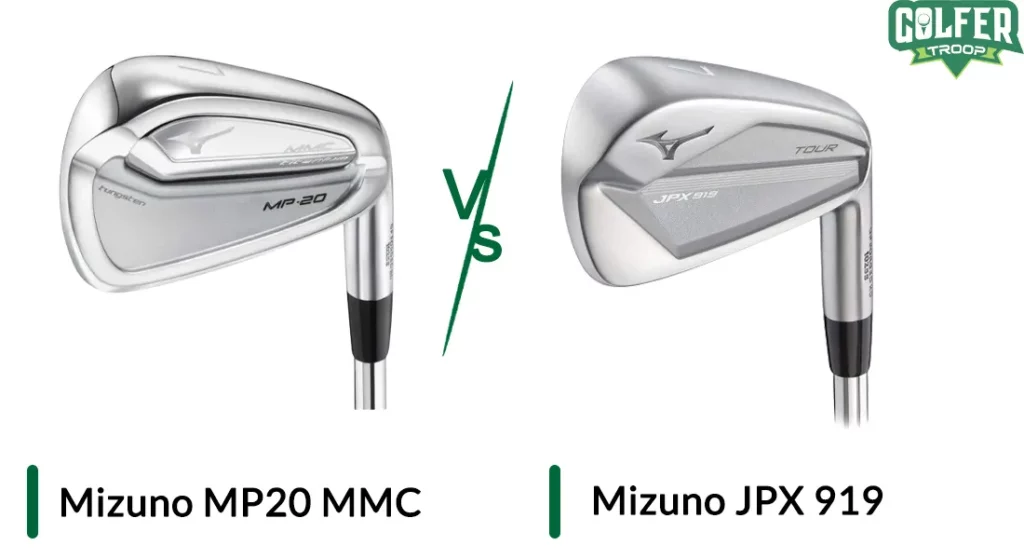
Both the MP-20 MMC and the JPX 919 Forged are high-end irons from Mizuno. They share a lot, so it can be hard to know which one to pick as your main set or your backup set.
Several differences will help you decide. These include how each head is built, the materials, the specs, the forgiveness and the type of golfer each iron is made for.
If you are a beginner, keep in mind that neither iron is aimed at high handicappers. Read to the end for the full Mizuno MP-20 MMC vs JPX 919 Forged comparison and a simple guide on which handicap fits each set.
Overview Of Mizuno MP20 MMC irons
Pros
- Premium, dynamic, and very sharp look.
- Made of multiple materials, including tungsten, titanium, copper and nickel
- Very firm and helps the golfer deliver consistent shots
- Good speed, lower spin, and higher touch when struck well.
- Decent feedback in every shot
Cons
- Lack of forgiveness
- Relatively tough to handle and requires skill for playing consistent shots.
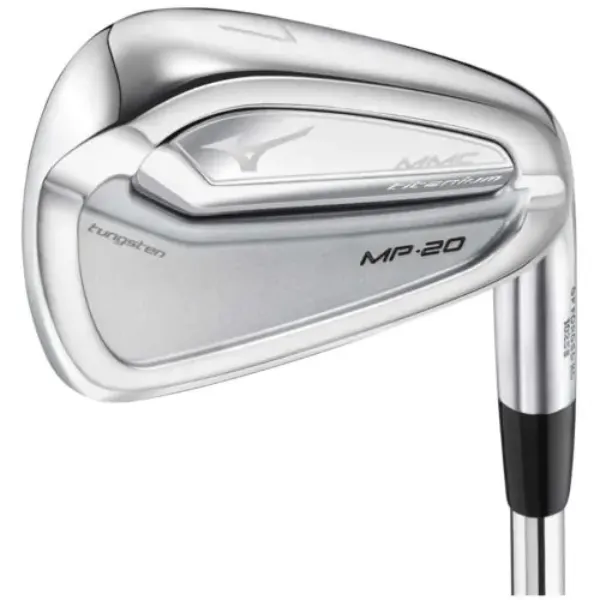
The MP-20 MMC (multi-material construction) is a player’s cavity iron. It feels firm, and it tells you clearly when you miss the center of the face.
That honest feedback is the point. It helps you learn where you strike the ball, which can make you more consistent and precise over time.
The “multi-material” part is real. In the 4- to 7-irons, Mizuno uses 12g tungsten sole weights plus a 12g titanium plate. The 8-iron to PW use a 10.5g titanium plate (source: GOLF.com).
Overview Of Mizuno JPX 919 Forged irons
Pros
- Pleasant look and aesthetic design
- More forgiving than the MP-20 MMC
- Boron-infused steel that Mizuno says is about 30% stronger
- Good feedback with consistent distances in every shot
- More compact and handy compared to other versions of JPX 919
- Deep reverse-milled face lowers and deepens the center of gravity
- Set includes a 51° gap wedge
Cons
- Not built for high handicappers or true beginners
- Older model, so new sets are hard to find
The JPX 919 Forged is a forged cavity iron for low to mid handicappers. According to Mizuno, it delivers more ball speed than a typical forged iron (source: Mizuno).
It also has more forgiveness than the MP-20 MMC. A stability frame that is open at the heel and a deeper, lower center of gravity help off-center hits hold up better. That can give golfers more confidence on the course.
The head is made from boron-infused 1025 carbon steel. Mizuno says the boron makes the steel about 30% stronger. That extra strength let Mizuno mill a thinner, wider face.
Mizuno MP20 MMC Vs. JPX 919 Forged irons: Quick Comparison Chart
Both the MP-20 MMC and the JPX 919 Forged are high-end irons from Mizuno. Use this table to see the key differences at a glance.
| Factors | MP20 MMC | JPX 919 Forged |
| Iron type | Player’s cavity, multi-material | Forged cavity with stability frame |
| Forgiveness | Limited | More forgiving of the two |
| Best handicap fit | Better players, mainly low handicaps | Low to mid handicaps |
| Main materials | Forged steel with tungsten, titanium, copper underlay and nickel-chrome finish | Boron-infused 1025 carbon steel |
| Forging | Grain Flow Forged | Grain Flow Forged |
| Lofts (4-iron to PW) | 22° to 46° | 22° to 46° (same) |
| Gap wedge | No | Yes, 51° |
| Launched | September 2019 | 2018 |
What Are The Differences Between Mizuno MP20 MMC And JPX 919 irons?
Here comes the big question: which specs differ between the MP-20 MMC and the JPX 919 Forged, and how do they change performance on the course?
At first glance, the two sets can look alike. The real differences show up in how each head is built and who it is designed for.
What are the lofts of each set?
The stock lofts are the same from the 4-iron to the PW. The JPX 919 Forged adds a 51° gap wedge, which the MP-20 MMC set does not include (source: Driving Range Heroes).
| Loft | 4 | 5 | 6 | 7 | 8 | 9 | PW | GW |
| MP20 MMC | 22° | 25° | 28° | 32° | 36° | 41° | 46° | NA |
| JPX 919 Forged | 22° | 25° | 28° | 32° | 36° | 41° | 46° | 51° |
Since the lofts match, loft is not why one set might fly farther than the other. Any distance gap comes from head design, strike quality and the shaft you choose.
What are the JPX 919 Forged lie angles and lengths?
The JPX 919 Forged stock lie angles run from 60° to 63° through the set. Stock lengths run from 38.5″ for the 4-iron down to 35.25″ for the gap wedge.
Stock lie, length and swing weight are only a starting point. Mizuno irons are commonly custom fit, so check lie angle at a fitting before you buy, new or used.
How do the designs differ?
The multi-material construction (MMC) version of the MP-20 has a premium look. It combines forged steel with tungsten, titanium, copper and nickel in different parts of the head.
The JPX 919 Forged looks more like a classic forged steel iron. It has a Pearl Brush finish, and its face is CNC reverse-milled from the sole up. Mizuno says this creates a larger area of minimum face thickness.
Which iron is more consistent?
Both irons can be very consistent in the right hands. The difference is who gets that consistency.
A skilled ball striker who hits the center often will get steady results from the MP-20 MMC. A golfer who misses the center more often will usually be more consistent with the JPX 919 Forged, because it holds up better on mishits.
How are they built?
Mizuno’s copper underlay is used in the MP-20 series. It is a single sheet of copper under a nickel-chrome finish, and it is designed to improve impact feel.
Both sets are made with Mizuno’s Grain Flow Forging process. Forging is meant to give a soft, consistent and solid feel at impact.
The JPX 919 Forged takes a different path. It uses boron-infused 1025 carbon steel, which Mizuno says is about 30% stronger. That strength allowed a thinner, wider face.
Mizuno also removed weight from the JPX 919 Forged face with a deep reverse-milled pattern. This lowers and deepens the center of gravity. A stability frame, open at the heel, adds more help on off-center hits.
Which iron performs better?
The MP-20 MMC is not a distance-focused iron. Its results are solid and, more importantly, predictable when you strike it well.
The JPX 919 Forged is built for more ball speed than a typical forged iron. Its thinner, wider face and deeper center of gravity also help keep ball speed up on off-center hits.
Both sets have the same stock lofts from 4-iron to PW. So the choice comes down to how much help you need on mishits, not loft.
We did not find verified launch monitor data that compares the two sets head to head. The best way to compare ball speed, spin and launch is to hit both on a launch monitor during a fitting.
Is the Mizuno MP-20 MMC forgiving?
Not very. The MP-20 MMC is a player’s cavity with limited forgiveness. It is built for golfers who hit the center of the face most of the time.
What it gives better players is control. It is versatile enough to shape shots, such as draws and fades, when you want to.
The JPX 919 Forged is the more forgiving of the two. Its stability frame and deeper, lower center of gravity give more help on mishits. Neither iron is aimed at high handicappers.
How do they compare in sound and feel?
Sound and feel matter to many golfers, but they are personal. Both irons are Grain Flow Forged, so both aim for a soft, solid feel.
The MP-20 MMC adds a copper underlay to improve feel at impact. It gives clear feedback, so you will know right away when you miss the center. The JPX 919 Forged feels a bit more muted on mishits because it is more forgiving. Try both if you can.
What Handicap Is Each Iron For?
The MP-20 MMC is for better players, mainly low handicappers. The JPX 919 Forged suits low to mid handicappers. Use this simple guide:
| Your game | Better fit |
| Low handicap, strike the center often, want to shape shots | MP-20 MMC |
| Low to mid handicap, want help on mishits and a gap wedge in the set | JPX 919 Forged |
| High handicap or beginner | Neither; look at a more forgiving game-improvement iron |
Are the MP-20 MMC irons good for mid handicappers?
Only for strong ball strikers. Most mid handicappers will get more help from the JPX 919 Forged, since the MP-20 MMC has limited forgiveness.
Is the JPX 919 Forged a game improvement iron?
Not in the high-handicap sense. It is a forged iron with added forgiveness, aimed at low to mid handicappers. High handicappers should look at more forgiving irons.
When Did These Irons Come Out, And Can You Still Buy Them?
The JPX 919 Forged came out in 2018. Mizuno introduced it in September 2018. The MP-20 series, including the MMC, went on pre-sale on September 5, 2019, and reached retail on September 20, 2019.
Both sets are several years old. Mizuno has released newer JPX Forged and MP-series irons since then. Today you will mostly find these two sets on the used market or as leftover stock.
Prices vary a lot by condition, shafts and set makeup, so we do not list a fixed price. Follow these steps before you buy a used set:
- Confirm the exact model. “JPX 919” also came in other versions, so make sure it says Forged.
- Check which clubs are in the set. The MP-20 MMC has no gap wedge, so you may need to add one.
- Ask for the shaft model, flex and length. Used sets are often custom built.
- Have the lie angles and lofts checked. Forged heads can be bent to fit you.
- Look at face and groove wear, especially on the short irons.
Mizuno MP20 MMC Or JPX 919 Forged Irons: Which One Should You Choose?
Mizuno’s MP-20 MMC and JPX 919 Forged are each good at different things. Your skill level and how often you hit the center of the face should drive the choice.
If you want a forged, sturdy and good-looking iron, both sets deliver. The MP-20 MMC rewards precise strikes and shot shaping. The JPX 919 Forged gives more ball speed and more help on mishits.
Choose the MP-20 MMC if you are a low-handicap player who strikes it well. Choose the JPX 919 Forged if you are a low to mid handicapper who wants more forgiveness and a matching gap wedge. If you are a beginner or a high handicapper, neither set is the best fit.
We hope this article helps you get the most compatible set of irons that complies with your playing style.
FAQs.
For even more detailed information about the comparison between Mizuno MP20 MMC vs. JPX 919, the following questionnaires would be helpful.
Does MP20 MMC have more coverage than JPX 919?
Not because of loft. Both sets have the same stock lofts from 4-iron to PW (22° to 46°). The JPX 919 Forged has a thinner, wider face that Mizuno says delivers more ball speed than a typical forged iron. For your own numbers, compare both on a launch monitor during a fitting.
Which players should choose MP20 MMC or JPX 919?
The MP-20 MMC is a player’s cavity with limited forgiveness, aimed at better players, mainly low handicappers.
The JPX 919 Forged is the more forgiving of the two and suits low to mid handicappers. Neither iron is aimed at high handicappers.
Is JPX 919 faster than MP20 MMC?
Mizuno says the JPX 919 Forged produces more ball speed than a typical forged iron, thanks to its boron-infused steel and thinner, wider face.
We did not find verified head-to-head data against the MP-20 MMC, so test both with your own swing before you buy.
Read Also: Mizuno MP20 Vs JPX 919 Tour | Which Golf Iron to Choose?
Read Also: Mizuno JPX 919 Forged vs. TaylorMade P790 Iron Comparison
Read Also: Mizuno Irons MP20 vs. MP18: Which One is Right for You?
Read Also: Mizuno MP-20 HMB Vs. Titleist T200: Which Iron Better Fits Your Needs?
Read Also: Mizuno MP 20 MMC vs Titleist T100S Irons: See the Difference
Read Also: Mizuno MP-20 MMC vs. Taylormade P790: Which Iron Reigns Supreme?