Quick answer: Graphite shafts are usually lighter, absorb more vibration and cost more, so they often suit slower swings. Steel shafts usually weigh more, last longer and give more feedback, so they often suit faster swings (above about 95 mph with a driver). Neither is only for beginners or pros. Test both before you buy.
Over the years, golf shafts have had a significant overhaul. Early golf shafts were made of wood such as hickory. Steel took over only after the USGA approved it in 1924 and the R&A approved it in 1929. Graphite came later. Frank Thomas began developing a graphite shaft at Shakespeare in 1968 and unveiled it at the PGA Merchandise Show in January 1970.
The main difference between graphite and steel shafts is how they fit your swing, not your skill label. Amateurs and professionals both play steel, and some tour professionals play graphite. Swing speed, tempo and fit should decide your choice.
But that’s not all when it comes to graphite vs steel shafts. Here’s a detailed look at how they differ.
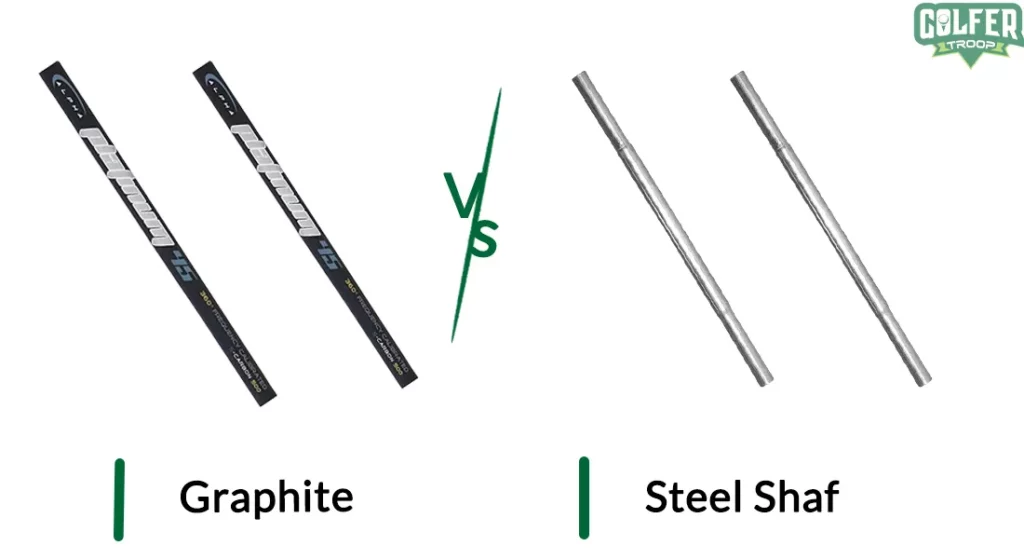
Graphite Vs Steel Shaft: Comparison Chart
Graphite and steel shafts have some distinct characteristics, but several specs depend on the club or model rather than the material. Let’s have a look at their features.
| Topic | Graphite Shaft | Steel Shaft |
| Tip Size | Set by tip type and clubhead fit | Set by tip type and clubhead fit |
| Butt Diameter | Check the model’s specs | Check the model’s specs |
| Vibration | Absorbs more vibration | Sends more vibration to the hands |
| Length | Set by club type and fit | Set by club type and fit |
| Weight | Usually lighter, but ranges overlap | Usually heavier, but ranges overlap |
| Ball Flight | Often higher, depending on the shaft | Often flatter, depending on the shaft |
| Forgiveness | Often seen as more forgiving | Often seen as less forgiving |
| Durability | Durable in normal use, but can chip or crack | Generally more durable |
| Price | Generally higher | Generally lower |
These are just the basic overview of the performance of each of the shafts. But it hardly tells the entire story. Each of these features has a different implication for different types of players.
What Are The Differences Between Graphite and Steel Shaft?
Graphite and steel differ most in weight, vibration, durability and price. They do not differ by default in length, tip size or flex labels.
Here is how each factor compares.
Are Graphite Shafts Lighter Than Steel?
Usually, yes. Graphite shafts commonly weigh about 40 to 90 grams, and some iron models reach 100 grams. Steel shafts commonly weigh about 90 to 130 grams, and some ultralight steel models weigh about 74 to 78 grams.
The ranges overlap. KBS makes its Tour PGI graphite iron shaft from 50 to 100 grams in 10-gram steps. A heavy graphite iron shaft can weigh more than an ultralight steel one, so compare the actual weight and not just the material.
Graphite shafts are composites. Frank Thomas’s first graphite shaft was a graphite-and-epoxy composite, not pure graphite.
Over the years, the graphite shaft has gone through significant evolution using different composite materials. Modern graphite is durable in normal use, but steel is still generally more durable.
Do Graphite Shafts Have More Torque?
Not automatically. Torque measures how much a shaft twists under a standard load, and it is reported in degrees.
Torque varies by model, weight and stiffness. Some very stiff graphite shafts have minimal torque.
Higher torque can suit slower swings, but it has to match your tempo. It will not let a moderate swinger match the distance of a fast swinger on its own.
How Is Flex Different From Torque?
Flex describes how a shaft bends. Torque describes how it twists. They are separate properties, so a shaft’s flex label does not tell you its torque.
Flex is usually labeled with letters such as L, A, SR, R, S, XS, X and TX. These labels describe stiffness, not material. You can find an R or S flex in both graphite and steel, but one brand’s S may not match another’s, so test them when you can.
Which Shaft Feels Better in Your Hands?
It depends on what you want to feel. Graphite absorbs more vibration, and steel transmits more vibration to the hands. Graphite often feels softer. Steel often feels more direct.
That softer feel has a trade-off. Because graphite absorbs more shock, some players find it harder to judge the quality of a strike.
Steel gives more feedback at contact. Golfers who value that feedback often prefer it.
Does Butt Diameter Differ Between Graphite and Steel?
Don’t assume that either material has a larger butt diameter. The butt is the grip end of the shaft, so check the spec sheet for the exact model you are considering.
Butt diameter may not seem like a huge thing, but it can affect how the grip fits and feels.
For people with larger hands, a larger grip size can help them hold the club comfortably and make more controlled shots. Ask a club builder how the shaft and grip will work together.
Are Graphite Shafts Longer Than Steel?
No. Shaft length depends on the club, not the material. Graphite can seem longer because it is common in long clubs such as drivers.
One builder lists these uncut shaft lengths:
- Woods: 46 to 50 inches
- Fairway woods: about 44 inches
- Hybrids: 41 to 42 inches
- Parallel-tip irons: 36.5 to 43.5 inches
Tall golfers should not pick graphite for extra length. Get the length fitted first, then choose the material based on swing speed and feel.
Are Graphite Shafts More Expensive Than Steel?
Generally, yes. When checked in November 2026, Grips4Less listed steel iron shafts at about $15 to $50 each. Its examples included True Temper Dynamic Gold at $32.99 and a Mitsubishi MMT composite iron shaft at $85.
UK brand Lynx lists a similar gap: about £15 to £65 for steel and £40 to £120 for graphite.
Prices change often and vary by model, so check current listings before you budget.
How Do the Technical Specs Compare?
| Factors | Graphite Shaft | Steel Shaft |
| Flex | Letter labels such as R, S and X | Letter labels such as R, S and X |
| Weight | About 40 to 90 g; some iron models reach 100 g | About 90 to 130 g; some ultralight models weigh about 74 to 78 g |
| Length | Depends on the club | Depends on the club |
| Tip Diameter | Iron shafts: .370 inch parallel or .355 inch taper | Iron shafts: .370 inch parallel or .355 inch taper |
| Butt Diameter | Check the model’s specs | Check the model’s specs |
| Launch | Often higher; depends on profile and weight | Often flatter; depends on profile and weight |
Tip size comes from the tip type and the clubhead, not the material. Iron shafts use a .370-inch parallel tip or a .355-inch taper tip. Some stiff graphite shafts are also built for low launch, so read the specs for each model.
Graphite or Steel Shaft: Which One To Choose?
Choose based on swing speed, tempo and how the shaft performs in a test. Skill level alone should not decide it. Personal preference still matters, especially when two shafts perform about the same.
What Swing Speed Should Use Graphite Iron Shafts?
Lynx Golf’s guide gives useful driver swing speed ranges. Use these as starting points:
- Above about 95 mph: Lynx suggests steel if you value control and feedback.
- About 85 to 95 mph: Either material can fit, depending on your strike and ball flight.
- Below about 85 mph: Start by testing graphite, because lower weight can help some players gain swing speed or ball speed.
Are Graphite or Steel Shafts Better for Beginners?
Neither is automatically better. A beginner with a slower swing should usually test graphite first, especially if steel feels heavy. A beginner with a fast swing may prefer the control and feedback of steel.
If budget is tight, steel irons generally cost less. Pair them with a graphite driver, since graphite is common in drivers.
What Should Seniors, Juniors, Women and Slower-Swing Golfers Choose?
Go by swing speed and comfort, not age or gender. Slower-swing golfers of any age are good candidates for lighter graphite, and higher torque can suit slower swings if it matches their tempo.
If you like the feel of steel but want less weight, try ultralight steel. Some models weigh about 74 to 78 grams.
Which Shaft Works Best in Each Club?
Graphite is the common choice in long clubs such as drivers. Irons are a true choice between the two materials, and wedges lean toward steel among professionals.
| Club | Starting Point | What To Check |
| Driver and woods | Graphite is common | Weight, flex and launch |
| Hybrids | Test both | Ball flight and how the weight blends with your irons |
| Irons | Steel for faster swings; graphite for slower swings | Swing speed, feedback and budget |
| Wedges | Steel is the most common choice among pros | Feel and weight compared with your irons |
| Putters | Personal preference | Feel at impact; try both if a shop has them |
Do Graphite Shafts Hit the Ball Farther Than Steel?
They can for some players, but it is not guaranteed. Any distance gain comes mainly from graphite’s lower weight, which can raise swing speed or ball speed for some players.
Graphite does not create a better loft angle. Check your carry distance and shot pattern together, because extra yards do not help if your misses get wider.
Are Graphite Shafts Easier on Your Elbows and Wrists?
They may feel easier, because graphite absorbs more vibration and steel sends more to the hands. Lower weight may also feel better to some golfers.
That does not mean graphite will prevent or treat an injury. If you have elbow or wrist pain, talk with a doctor or physical therapist before you spend money on new shafts.
Do PGA Tour Pros Use Graphite or Steel Iron Shafts?
Most use steel, but not all. Steel remains the most common choice in irons and wedges at the professional level. Some tour players use graphite, either in full iron sets or in long irons.
What pros play should not decide what you play. Your swing speed and tempo matter more.
Do Graphite Shafts Break More Easily Than Steel?
Graphite is durable in normal use, but steel is generally more durable. Graphite can chip or crack from hard impacts.
A few simple habits help protect either type of shaft:
- Check shafts for chips, cracks and other visible damage after a hard impact.
- Avoid letting clubs bang together in the bag or during travel.
- Stop using a shaft with a crack or a deep chip, and have a club builder inspect it.
- Replace a shaft based on its condition and fit, not on a set date.
How Much Does It Cost To Reshaft Golf Clubs?
Start with the price of the shafts, then add labor and any new grips. At the Grips4Less prices above, eight steel iron shafts at $15 to $50 each would cost $120 to $400. Eight composite shafts at $85 each would cost $680.
Labor varies by shop, so ask for a written quote per club. Make sure it covers the shaft, grip, installation and any extra fitting work. Also confirm that the new shaft’s tip fits your clubhead.
Can You Mix Graphite and Steel Shafts in the Same Set?
Yes. A graphite driver with steel irons is already a mixed set. Some tour players go further and use graphite only in their long irons.
Watch for big weight jumps between clubs, because a sudden change can make the set feel uneven. Multi-material shafts that combine steel and graphite are another option. Judge them by the same tests: weight, flex, launch and feel.
How Should You Test Shafts Before Buying?
A fitting or side-by-side demo is the most reliable way to choose. Follow these steps:
- Measure your driver swing speed.
- Hit graphite and steel in the same club type, using the same head if possible.
- Compare ball speed, carry distance, launch, spin and shot pattern.
- Ask the fitter to explain each shaft’s weight, flex, torque and kick point, which is the part of the shaft that bends most.
- Notice how each shaft feels near the end of the session, when you are more tired.
- Confirm the tip fit and the total price before you order.
Pick the shaft that gives you the most consistent results, not the one that produced your single longest shot.
Frequently Asked Questions (FAQs)
Now let’s look at some of the most common questions regarding graphite vs steel shafts.
Which One Covers More Distance Between Graphite And Steel Shaft?
Graphite can add distance for some players because its lower weight can raise swing speed or ball speed. It does not get a better loft angle, and the gain is not guaranteed. Test both with your own swing.
Which Is Cheaper Between Graphite And Steel Shafts?
Steel shafts generally cost less than graphite shafts. When checked in November 2026, one US retailer listed steel iron shafts at about $15 to $50 each and a composite iron shaft at $85.
Which Is Best For Tall People?
Neither material is longer by nature. Shaft length depends on the club and your fit. Tall golfers should get fitted for length, then choose graphite or steel based on swing speed and feel.
Which Is More Durable Between Graphite And Steel Shafts?
The answer is up for debate as it mostly depends on the play. However, in general use, steel shafts tend to last more than graphite shafts as it is more rigid and durable.
Related Posts: