
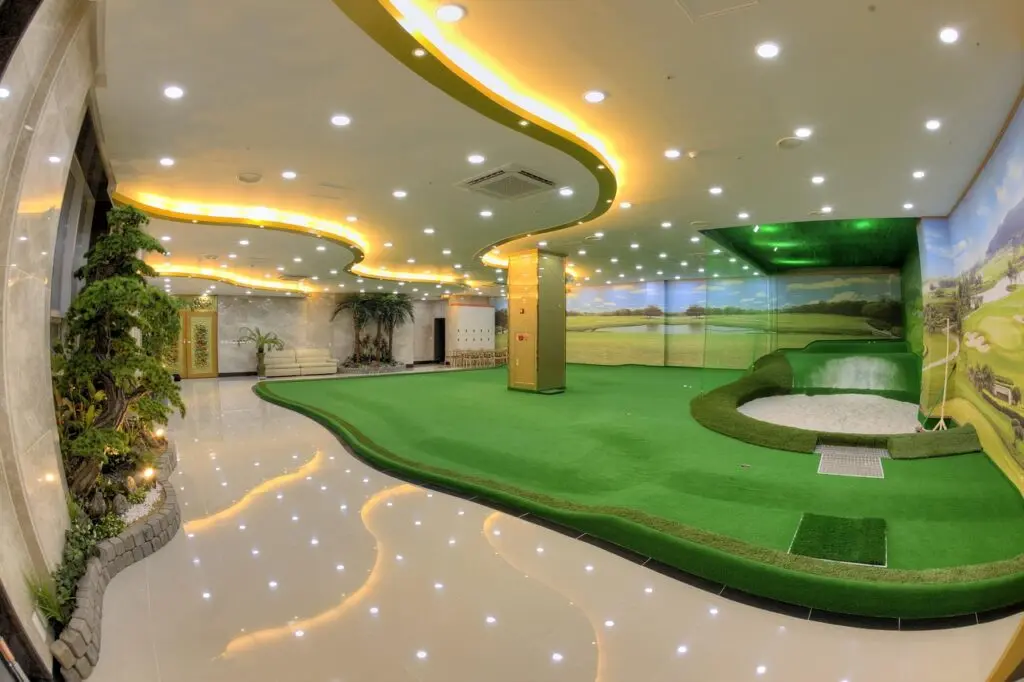
Most golfers need a room about 10 ft wide, 15 ft deep and 9 ft high to run a golf simulator with a driver. If you want space to swing freely, aim for 12-16 ft wide, 18-20 ft deep and 10 ft high. The type of launch monitor you buy can push those golf simulator space requirements up or down, so check that before you buy a screen or enclosure.
How much space do you need for a golf simulator?
The minimum room size for a golf simulator is about 10 ft wide x 15 ft deep x 9 ft high. A comfortable room is about 12-16 ft wide x 18-20 ft deep x 10 ft high. Below the minimum, full driver swings get risky or impossible.
| Dimension | Minimum | Comfortable | Notes |
|---|---|---|---|
| Ceiling height | 9 ft | 10 ft or more | Tall golfers and ceiling-mounted monitors need the higher number. |
| Width | 10 ft | 12-16 ft | Go 14-15 ft or more if both right- and left-handed golfers will play. |
| Depth | 15 ft | 18-20 ft | Radar units that sit behind the ball need the most depth. |
These are general guides. Your launch monitor and enclosure come with their own space specs, and those specs set your final numbers. For example, Trackman recommends a ceiling of 10 ft or higher and a room width of 15 ft or more for both Trackman iO and Trackman 4.
What ceiling height do you need for a golf simulator?
A 9 ft ceiling is high enough for most golfers. MyGolfSpy calls 9 ft the sweet spot and says 10 ft or more is best for tall golfers and ceiling-mounted launch monitors. Here is how each height band plays out:
- Under 8 ft: Not suitable for full swings. Trackman does not recommend even an 8 ft ceiling for full swings.
- 8-8.5 ft: Workable for wedges, short irons and a controlled half swing. Some compact enclosures are built for this height, but a full driver swing is likely to hit the ceiling.
- 9 ft: Fits most golfers with a full driver swing. Run the driver test below to be sure.
- 10 ft or more: Best for tall golfers, steep swings and launch monitors that mount on the ceiling.
Your swing height matters more than how tall you are. A shorter golfer with a long, upright backswing can need more room than a taller golfer with a compact swing. The clubhead’s highest point is the number that counts.
Ceiling-mounted monitors raise the bar. Uneekor’s QED sensor mounts 9 to 10.5 ft off the floor, so a room that just clears your swing may still be too low for the unit.
Also look up before you commit. Light fixtures, beams, ductwork and garage door tracks can sit well below the ceiling. Measure to the lowest object above your swing, not to the drywall.
How to test your ceiling with a driver
- Stand on your hitting mat, or on something the same thickness.
- Make your fullest, slowest driver backswing. Don’t swing at speed.
- Have someone mark the highest point the clubhead reaches.
- Measure from the floor to that mark.
- Add 6 inches. That total is your minimum ceiling height.
How wide should a golf simulator room be?
A golf simulator room should be at least 10 ft wide. About 12 ft lets one golfer hit from a slightly off-center tee. If both right- and left-handed golfers will play from a centered tee, plan on about 14-15 ft or more.
Why the extra width for mixed-handed players? A centered tee needs swing room on both sides. SkyTrak advises adding 1-2 ft of width if both left- and right-handed golfers will use the simulator.
Leave side clearance around the enclosure too. Most enclosures are about 10 ft wide and need at least 6 in of clearance on each side. A foot on each side makes setup and cleanup easier.
How deep does a golf simulator room need to be?
A golf simulator room needs to be at least 15 ft deep. The ideal depth is 18-20 ft. Depth is made of three parts:
| Depth zone | Typical space | What it’s for |
|---|---|---|
| Behind the ball | About 7 ft | Your stance and backswing |
| Ball to screen | 10-12 ft | Ball flight, so the ball slows and the screen can absorb it |
| Screen to back wall | 12-16 in | Room for the screen to flex without hitting the wall |
Those numbers come from MyGolfSpy’s depth breakdown. Add them up and you land near 18-20 ft. Squeeze each zone and you reach the 15 ft minimum.
How far should the ball be from a golf simulator screen?
Plan on 10-12 ft from the ball to the screen. Trackman iO, for example, needs 10 ft or more from screen to ball. Closer than that, the ball hits the screen harder and is more likely to bounce back at you.
Can you fit a golf simulator in a 10×10 room?
Not for full driver swings. A 10 x 10 ft room is short on depth by at least 5 ft. Trackman says even a 12 x 12 ft room may allow short-iron swings but will likely feel cramped with a driver. Rooms that size work best for putting, chipping or wedge practice.
Does your launch monitor change how much space you need?
Yes. Your launch monitor has the biggest effect on depth. Radar units that sit behind the ball need more depth. Units that sit beside the ball need less.
| Launch monitor placement | Minimum depth | Comfortable depth | Example |
|---|---|---|---|
| Radar behind the ball | 16 ft | 18 ft or more | Garmin Approach R10, Trackman 4 |
| Unit beside the ball (camera/photometric) | 15 ft | 16 ft | SkyTrak |
The depth numbers above are from MyGolfSpy. Use them as a starting point, then check the maker’s spec sheet before you plan the room. The spec sheet always wins.
Radar launch monitors
Many radar units sit behind you and track the ball as it flies toward the screen. That means they need floor space behind your swing area as well as ball-flight space in front.
- Garmin Approach R10: Garmin’s setup guide says to place it on the ground 6 to 8 ft behind the ball, with its alignment line pointed at the ball and target.
- Trackman 4: Needs 18 ft or more from the screen to the unit.
So how much space do you need behind the ball for a radar launch monitor? Plan on up to 8 ft. SkyTrak notes that behind-the-ball launch monitors can need that much space behind the hitting area.
Side-placed (camera) launch monitors
Units that sit beside the ball, like SkyTrak, only need floor space next to the tee. You still need room for your backswing, but you don’t need extra space behind it for the device. Some radar units also sit beside the ball. The Garmin Approach R50 manual says to place it about 1.5 ft to the side of the tee, aimed at the tee, at roughly the same height as the tee.
If your room is short on depth, a side-placed unit is usually the better fit.
Enclosure, net or screen: how much room does each take?
An enclosure’s footprint is much smaller than the room it needs. SkyTrak’s Studio enclosures are a good real-world example:
| Enclosure | Footprint (W x D x H) | Minimum room (W x D x H) | Ideal room (W x D x H) |
|---|---|---|---|
| SkyTrak Studio 8′ | Not listed here | 8.5′ x 15′ x 8′ | Not listed here |
| SkyTrak Studio 10′ | 10′ x 5’4″ x 8’6″ | 11′ x 16′ x 9′ | 12′-14′ x 17′-20′ x 9′-10′ |
| SkyTrak Studio 13′ Deep | Not listed here | 14′ x 17′ x 10’6″ | Not listed here |
The Studio 10′ enclosure is only 5’4″ deep, but SkyTrak still asks for a room at least 16 ft deep. The extra depth covers your stance, your swing and the ball’s flight to the screen. Always plan around the minimum room size, not the footprint.
A return net needs more space from the wall than an enclosure does. The net gives when the ball hits it and pushes the ball back toward you. Leave enough room behind it so it never touches the wall at impact.
To protect walls and ceilings around your setup, see our guide to golf simulator wall padding.
How do you measure your room for a golf simulator?
Measure and test your space before you buy anything. This takes about 20 minutes and a helper.
- Measure the ceiling height at the spot where you plan to hit.
- Measure the room width at the hitting spot.
- Measure the depth from the front wall to the back wall.
- Mark the tee spot with tape, leaving 10-12 ft between it and where the screen will go.
- Mark where your launch monitor will sit, using the maker’s placement guide.
- Stand on a mat at the tee spot and make slow, full driver swings.
- Have your helper mark the highest point of the clubhead and add 6 inches.
- Check for lights, beams, ducts, doors and garage door tracks in your swing path.
Compare your numbers to the table at the top and to your launch monitor’s spec sheet. If every number clears, your room works.
Will a golf simulator fit in a one-car garage?
It can, but only if it passes the same test. One-car garages vary a lot in size. If yours measures at least 10-11 ft wide, 15-16 ft deep and 9 ft high to the lowest obstruction, a single-golfer setup can work. Watch the garage door track and opener, which often hang lower than the ceiling.
What if your room is too small?
A small room doesn’t always rule out a simulator. It changes what you buy and how you swing. Use these rules:
- Ceiling under 9 ft: Plan on irons and wedges, or a shorter, controlled driver swing. Skip ceiling-mounted launch monitors.
- Depth under 15 ft: Choose a launch monitor that sits beside the ball, not behind it.
- Width is tight: Use an offset tee and a single-handed setup.
- Room is about 10 x 10 or 12 x 12 ft: Treat it as a short-game and short-iron space, not a full-swing simulator.
Safety warning: Never swing where the club could hit the ceiling, a light or a beam. Never hit where a ball could rebound into people, pets or windows. If the test swing comes close, don’t take full swings in that room.
Frequently Asked Questions
Is a 9 ft ceiling high enough for a golf simulator?
Yes, a 9 ft ceiling is high enough for most golfers to swing a driver. Tall golfers, steep swings and ceiling-mounted launch monitors call for 10 ft or more. Test it first. Make a slow, full driver backswing, mark the clubhead’s highest point and add 6 inches. That is your minimum ceiling height.
How much space do you need behind the ball for a radar launch monitor?
Plan on up to 8 ft behind the hitting area for a radar launch monitor that sits behind the ball. Garmin’s setup guide places the Approach R10 6 to 8 ft behind the ball. Radar units also need ball-flight room in front of you, so plan on a room at least 16 ft deep.
How wide should a golf simulator be for left- and right-handed golfers?
Plan on about 14-15 ft or more if both right- and left-handed golfers will hit from a centered tee. A centered tee needs swing room on both sides. SkyTrak advises adding 1-2 ft of width for mixed-handed use. A single golfer can often manage with about 12 ft and an offset tee.
Can you use a golf simulator with an 8 ft ceiling?
An 8 ft ceiling works for wedges, short irons and controlled half swings, but not full driver swings. Trackman does not recommend an 8 ft ceiling for full swings. Some compact enclosures are built for this height. Skip ceiling-mounted launch monitors, and never swing where the club could hit the ceiling or a light.
How much space should be between a golf simulator screen and the wall?
Leave about 12-16 inches between a golf simulator screen and the back wall. That gap lets the screen flex when the ball hits it without striking the wall. A return net needs more room than an enclosure screen because it gives more at impact. Leave enough space that the net never touches the wall.