
Quick answer: A 52 degree wedge is usually a gap wedge for full-swing approach shots. A 56 degree wedge is usually a sand wedge for bunkers, pitches and high, soft shots. Most golfers with a modern, strong-lofted pitching wedge benefit from carrying both. Pick the 52 for full-swing yardage and the 56 for sand and greenside help.
Most guides on the 52 vs 56 degree wedge question stop at “gap wedge vs sand wedge.” This guide goes one step further. It shows you how to use your own pitching wedge loft to decide which wedge you need. It also gives you a simple rule if you only have room for one.
52 vs 56 Degree Wedge: What’s the Short Answer?
The 52° is usually a gap wedge. You hit it with full and three-quarter swings into the green. The 56° is usually a sand wedge. You use it in bunkers, for pitches and for shots that need to land soft.
If your iron set is modern, carry both. Today’s pitching wedges have strong lofts. That leaves a big yardage hole between the pitching wedge and a 56. The 52 fills that hole.
Decision rule: If you need more full-swing yardage options, choose the 52. If you need help from sand and around the green, choose the 56.
What Is the Difference Between a 52 and 56 Degree Wedge?
The main difference is 4° of loft. That changes how high and how far the ball flies. It also changes what each club is built to do.
| Feature | 52° wedge | 56° wedge |
|---|---|---|
| Usual name | Gap wedge (sometimes “approach” or “attack” wedge) | Sand wedge |
| Main role | Full and partial approach shots | Bunkers, pitches, short-game finesse |
| Typical bounce | Usually low to mid | Usually mid to high |
| Ball flight | Lower, more roll | Higher, softer landing |
| Best use | Full-swing club | Finesse and sand club |
Loft and Ball Flight
Loft is the angle of the clubface compared to a vertical line. More loft sends the ball higher and shorter. So a 56° launches higher, carries less and stops faster than a 52° hit with the same swing.
Is a 52 Degree Wedge a Gap Wedge or a Sand Wedge?
A 52° is almost always treated as a gap wedge. Vokey describes a sand wedge as having 54° to 56° of loft. Labels vary by brand, though. Some sets stamp a 52 as “G,” “A” or “AW.” Go by the loft number, not the letter.
Typical Bounce on Each Wedge
Bounce is the angle on the sole that helps the club glide instead of dig. Gap wedges like the 52 usually come with less bounce, which suits full swings off the fairway. Sand wedges like the 56 usually come with more bounce, which helps in sand and soft turf.
Full Swings vs Short-Game Shots
Think of the 52 as the last club in your iron set. Think of the 56 as the first club in your short-game kit. You can hit full shots with a 56 and chips with a 52. But each one works best in its main job.
How Far Do You Hit a 52 vs a 56 Degree Wedge?
Vokey says most golfers hit a 56° sand wedge 80 to 100 yards with a full swing. Vokey puts a 54° at about 85 to 105 yards.
For the 52, use spacing instead of a fixed number. Vokey recommends 4° to 6° of loft between wedges, which gives about 10 to 15 yards between clubs. So a 52 usually carries about one gap, roughly 10 to 15 yards, longer than your 56.
Charts are only a starting point. Your swing speed, strike and ball all change the numbers. Here’s how to find your real yardages:
- Hit 10 full shots with each wedge on a range with marked targets or a launch monitor.
- Throw out the worst two or three mishits.
- Write down the average carry distance, not total distance.
- Repeat with a half swing and a three-quarter swing.
Why Your Pitching Wedge Loft Decides Which One You Need
Your pitching wedge loft is the key number. It tells you how big the gap is between your irons and your wedges.
Pitching wedges have gotten stronger. MyGolfSpy puts game-improvement pitching wedges at about 41° to 43°, while a traditional players’ iron PW is about 45° to 46°. Titleist’s own irons show this. The T150 pitching wedge is 44°, and the T200 and T350 pitching wedges are 43°. Both are stronger than Vokey’s standard 46° pitching wedge.
Here’s the math. Say your PW is 43° and your next club is a 56°. That’s a 13° gap. Vokey recommends 4° to 6°. A 13° jump leaves a big yardage hole you’ll try to fill with awkward half swings.
What Wedge Should I Get After My Pitching Wedge?
Start with your PW loft and add 4° to 6°. Vokey gives the example of a 44° PW pairing with a 48° or 50° gap wedge. Find your PW loft on the maker’s spec page, then use this table:
| Your PW loft | Next wedge | Sand wedge | Notes |
|---|---|---|---|
| 41–42° | 46° or 47°, then 50° or 51° | 54°–56° | Very strong PW; you may need two gap wedges |
| 43–44° | 48°, then 52° | 56° | Vokey’s SM6 example uses a 43° PW with 48°, 52° and 58° |
| 45–46° | 50° or 52° | 54° or 56° | Vokey’s SM6 example uses a 45–46° PW with 50°, 54° and 58° |
The SM6 set examples come from Vokey’s gapping guide. Notice that a 52 is the right next club only if your PW is around 46° to 48°. With a stronger PW, you’ll want something weaker than the PW but stronger than the 52 first.
When Should You Use a 52 Degree Wedge?
- Full and three-quarter approach shots that are shorter than your PW distance.
- Longer chip-and-runs where you want less time in the air and more roll.
- Some bunker shots, such as firm sand or long greenside bunker shots.
Since you’ll swing it fully most of the time, consider the gap wedge that matches your iron set. Golf Digest recommends matching the gap wedge to your short irons and pitching wedge because it will likely be a full-swing club.
Can You Use a 52 Degree Wedge Out of a Bunker?
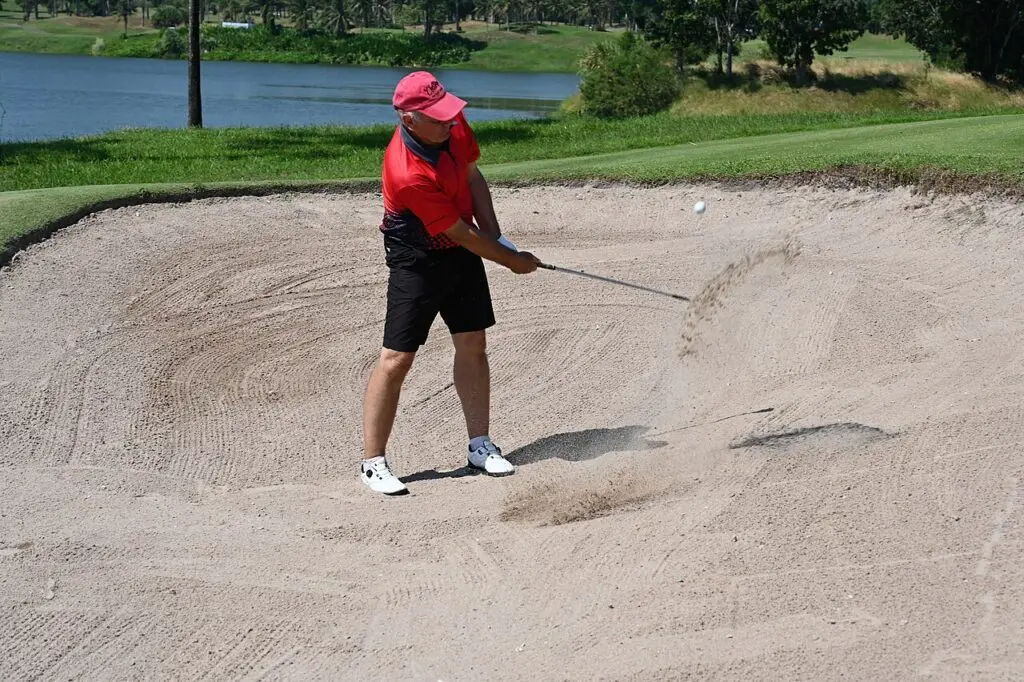
Yes, in the right conditions. A 52 can work from firm sand or when you need the ball to fly farther, like a long bunker shot. In soft, fluffy sand, a 52 with low bounce is more likely to dig. A 56 is usually the safer choice there.
When Should You Use a 56 Degree Wedge?
- Greenside bunkers. Higher bounce helps the club slide through soft sand.
- Pitches that need height and a quick stop on the green.
- Short-sided chips where there’s little green to work with.
- Fluffy lies in the rough near the green.
The 56 is a proven, all-purpose loft. Vokey says the 56° is the most-played loft on tour.
If You Can Only Carry One, Which Should You Pick?
Use your current bag and your biggest weakness to decide.
| Your situation | Pick first | Why |
|---|---|---|
| Strong PW (43–44°), no gap wedge, already have a sand wedge | 52° | Shrinks the biggest yardage gap |
| Strong PW, no gap wedge, no sand wedge | 56° | Covers bunkers and most short-game shots |
| You struggle in bunkers | 56° | More bounce for sand |
| You already have a set-matching 50° gap wedge | 56° (or 54°) | Keeps spacing at 4–6° |
| You have big gaps on full shots from 100 yards in | 52° | Gives you a full-swing option |
Is a 52 or 56 Degree Wedge Better for Beginners?
For most beginners, the 56 is the better first wedge. It handles the widest range of short-game shots, including bunkers, pitches and chips. Many beginner and game-improvement sets already include a gap wedge, which can cover full swings.
What About Mid-Handicappers?
Carry the 52 and 56 as a pair once your PW loft supports it. Then decide whether you need a lob wedge later. Our 58 vs 60 degree wedge guide covers that choice.
The trade-off: The Rules of Golf limit you to 14 clubs. Adding a wedge may mean dropping a long iron, hybrid or fairway wood. If you rarely hit your 4-iron well, it’s often the first club to go.
What Bounce Should a 52 and 56 Degree Wedge Have?
For the 52, lower or mid bounce usually suits full swings off the fairway. For the 56, mid to high bounce is common. Vokey’s SM10 54° and 56° sand wedges are offered in roughly 8° to 14° of bounce across its M, S, D and F grinds.
What Bounce Should a 56 Degree Wedge Have?
Match it to your course and swing. Titleist defines high bounce as more than 10°, designed for soft turf, fluffy lies and bunkers with soft sand. If your course has firm turf and firm sand, a mid-bounce 56 may suit you better. For a full breakdown, see our guides “What Is Bounce on a Wedge?” and our wedge grind explainer.
Do You Need Both a 52 and a 56 Degree Wedge?
Most golfers with a modern iron set do. Vokey’s pairing rule is simple: a 52° gap wedge pairs with a 56° sand wedge, and a 50° gap wedge pairs with a 54°. Both keep the spacing at 4°.
Do I Need a 52 Degree Wedge If I Have a 56?
Check the gap between your PW and your 56. If it’s more than 6° of loft, or more than about 15 yards of carry, you need a club in between. That club is often a 52, though a 50 may fit better with a stronger PW.
Should I Carry 52, 56 and 60 Degree Wedges?
A common four-wedge setup is PW + 52 + 56 + 60 (or 58). It gives you even 4° spacing and a lob wedge for high, short shots. It works best if your PW is around 46° to 48°. With a 43° or 44° PW, a 48 + 52 + 56 setup closes the full-swing gaps first.
Quick Wedge Gapping Checklist
- Look up your pitching wedge loft on the maker’s spec page.
- Measure your full-swing carry with each wedge you own.
- Look for any gap over 15 yards or over 6° of loft.
- Fill the biggest gap first, using 4° to 6° spacing.
- Choose bounce based on your sand and turf conditions.
52 vs 56 Degree Wedge FAQ
How many degrees of loft should be between your wedges?
Aim for 4° to 6° of loft between each wedge. Vokey recommends this spacing, and it usually works out to about 10 to 15 yards of carry between clubs. A gap bigger than 6°, or bigger than about 15 yards, leaves a hole you will try to fill with awkward half swings.
Should your gap wedge match your iron set?
Often, yes. Golf Digest recommends matching the gap wedge to your short irons and pitching wedge, because you will likely swing it fully most of the time. A set-matching gap wedge tends to feel and fly like your irons. Sand and lob wedges are where specialty wedges with different bounce options make more sense.
Does a 56 degree wedge hit the ball higher than a 52?
Yes. The 56° has 4° more loft, so with the same swing it launches higher, carries a shorter distance and stops faster on the green. The 52° flies lower and rolls more. That is why the 52 suits full approach shots and the 56 suits pitches, bunkers and shots that need a soft landing.
What club should you drop to add another wedge?
Drop the club you hit least well or use least. The Rules of Golf limit you to 14 clubs, so adding a wedge means removing a long iron, hybrid or fairway wood. For many golfers, a 4-iron they rarely strike well is the first club to go.
What is the most popular wedge loft on tour?
The 56° is the most-played wedge loft on tour, according to Vokey. It is a proven, all-purpose sand wedge loft. It handles greenside bunkers, high pitches, short-sided chips and fluffy lies in the rough, which is why many golfers choose it as their main short-game club.